AI-Written Medical Content: What Needs Checking Before Publication?
A convincing draft still needs its claims checked. Explore the reference, clinical meaning, medication, and audience checks an AI-assisted medical article needs before publication.
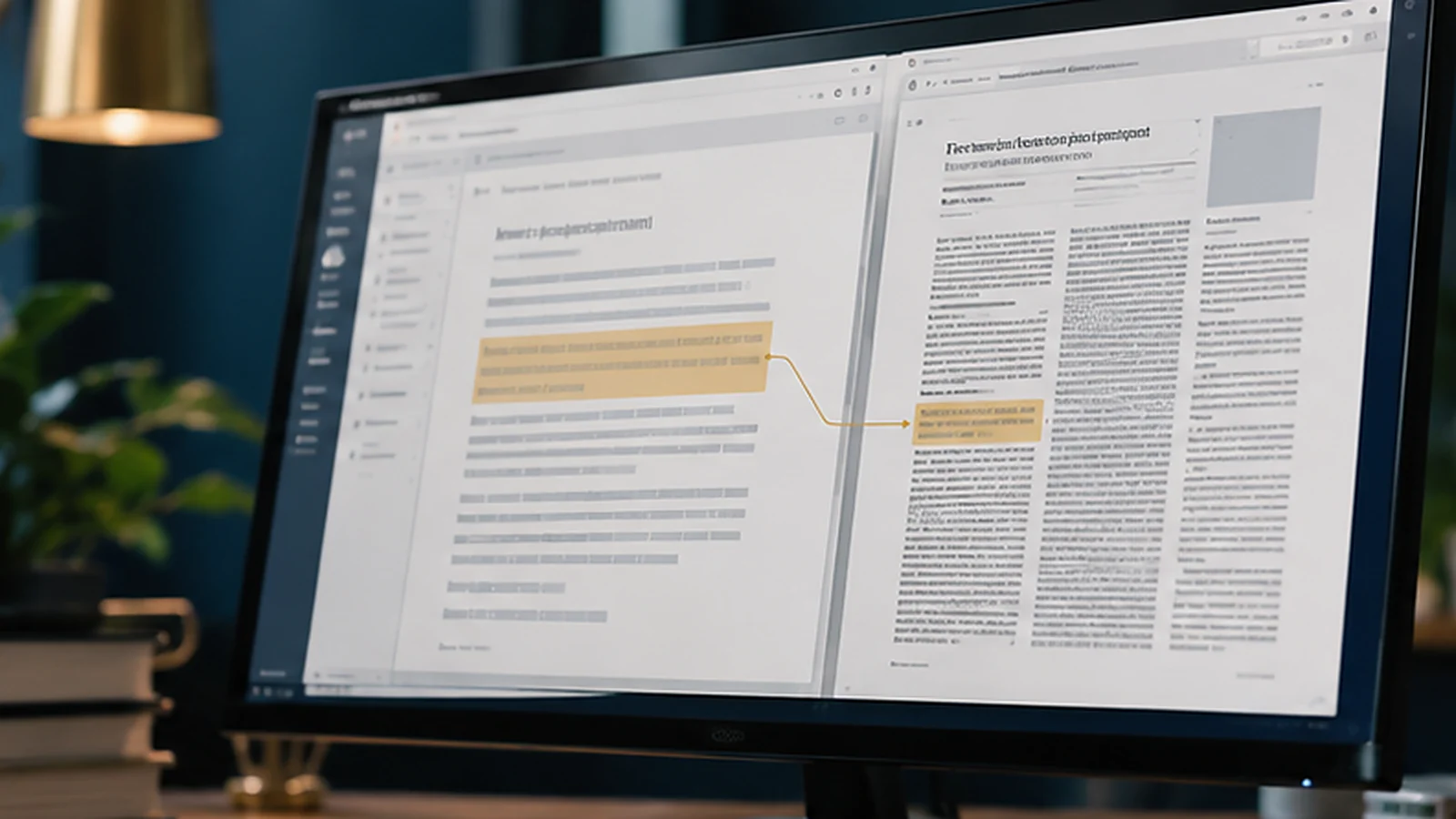
Quick answer
AI medical content review examines whether a draft’s clinical claims match its sources, medication details are accurate, and important population and outcome context is preserved. Agree annotated findings, revisions, evidence research, and any recheck in the project proposal.
Have an article or manuscript to review? Request a Review Quote.
AI medical content review checks whether an AI-assisted draft is accurate, supported by its references, and appropriate for its reader. A polished paragraph is the starting point. The next question is whether it deserves to be published.
Imagine an editor opening a medication article generated from a detailed prompt. The headings are sensible. The tone is reassuring. Five references sit at the bottom. Then the editor opens the first paper and discovers that it studied a different group of patients.
That is the kind of mismatch a clinical review should make visible. PharmacoLegal Consulting Services™ reviews medication-related content and clinical claims, with annotated findings and recommended revisions agreed for your project. Explore clinical content review or request a review quote.
What AI medical content review should check first
Start with statements a reader might act on: what a medicine does, who it is for, how it is used, and what benefits or harms to expect. Then work through the evidence behind those statements.
ICMJE advises authors to examine and edit AI-assisted content because it can be incorrect, incomplete, or biased. Responsibility for submitted work remains with people.[1] For a healthcare publisher, that gives the review a practical purpose: decide which passages are supported, which need revision, and which need more evidence.
The review should assess the content in front of it. An AI-detection score does not answer those clinical questions.
1. Open the references and check the connection
Check that each cited source exists and that its title, authors, date, and identifier match the reference supplied. Then read the relevant material.
A real source can still be the wrong support. It may concern a different treatment, population, dose, outcome, or follow-up period. A paper about a topic is not automatically evidence for every sentence written about that topic.
Mark the specific passage supporting the claim. If it cannot be located, record that gap. The claim-to-reference guide explains how to make this check useful rather than merely confirm that a link opens.
2. Check what the wording asks the evidence to prove
Watch the verbs. “Was associated with,” “reduced,” “prevented,” and “proved” make different claims. Also watch words such as “all,” “always,” and “safe”: they can stretch a limited finding into an assurance the source does not establish.
Read the population and outcome together. Does the sentence preserve who was studied and what was measured? Does it turn an observation into a treatment recommendation? The medication-study reading guide walks through those questions.
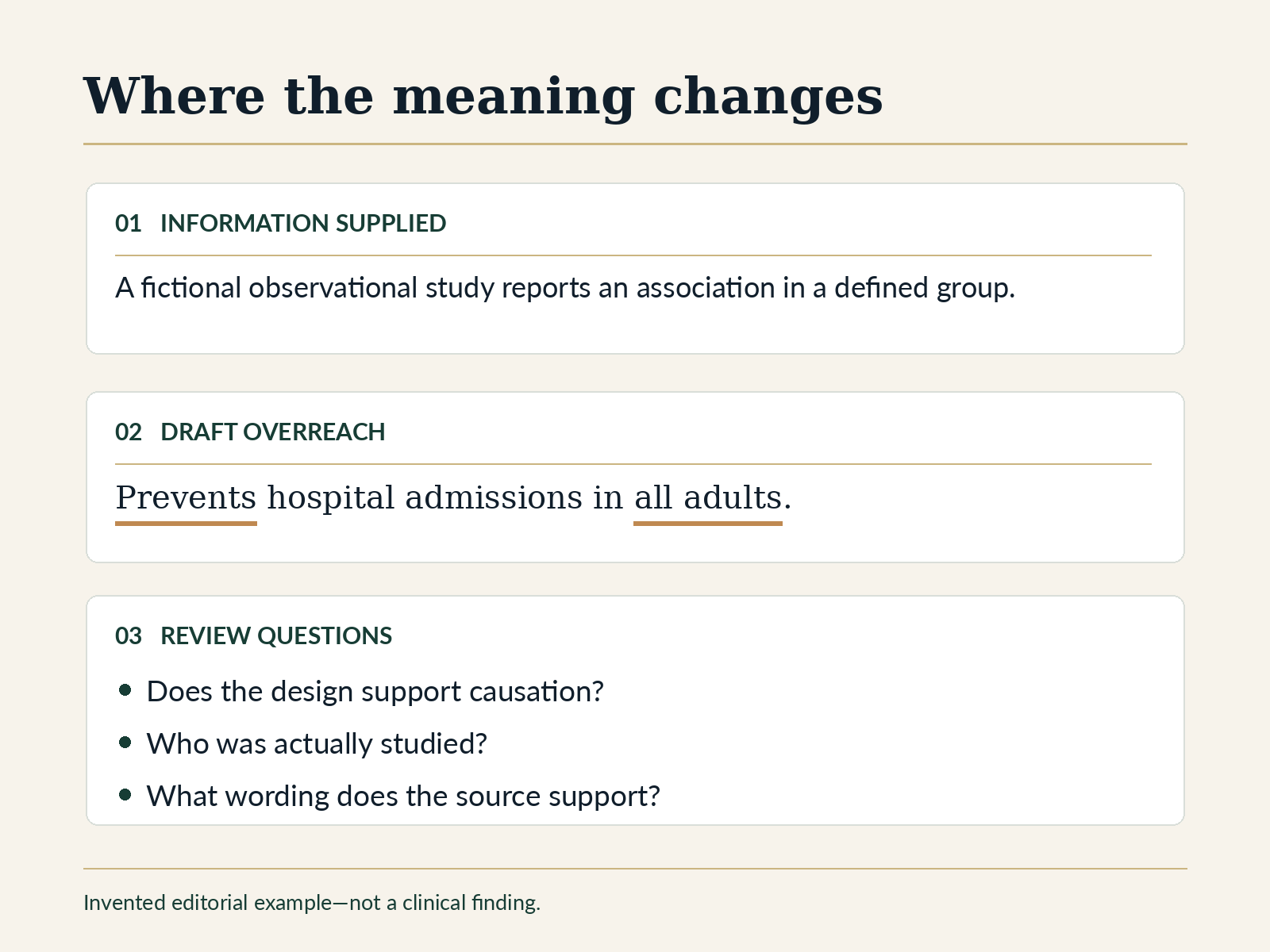
An example: a claim that gets bigger in the rewrite
Original editorial demonstration. The statements below are invented to show a review task; they do not report a study or describe a client engagement.
- Information supplied
- A fictional observational study reported an association between treatment use and fewer hospital admissions among adults with a defined condition.
- Draft sentence
- “This treatment prevents hospital admissions in all adults.”
- What changed?
- The draft turns an association into prevention and expands a defined study population to all adults.
- Review action
- Return to the actual source. Describe the observed association and relevant population, and preserve the uncertainty required by the study design. Establish whether any broader claim has separate support.
The comment gives an editor a decision to make. It also avoids inventing a replacement clinical claim before the real evidence has been examined.
3. Check the medication details
Review medicine names, formulations, routes, units, and the context for any dose or treatment instruction. A small-looking wording error can change the meaning of the passage.
For content discussing approved uses, warnings, or treatment recommendations, check the relevant current prescribing information or guidance for the intended jurisdiction. Record which version supports the statement. A reference from an earlier year may still be useful, but currency must be assessed against the specific claim.
Keep the source work visible in the findings. A comment such as “check dose” leaves the next person with the investigation; a useful finding identifies the passage, concern, source, and required action. See the clinical review report guide for a practical handoff.
4. Read it as the intended reader
A patient resource needs to explain the message in language its reader can use. Check whether simplification removes an important qualification, or whether a general explanation sounds like an instruction to change treatment.
CDC’s Clear Communication Index provides a research-based framework for assessing public communication.[2] Clear structure and plain wording help readers, while clinical assessment checks that the explanation remains accurate.
The physician-and-patient writing guide shows why the same evidence may need different explanations.
What should your team receive?
A defined review can provide an annotated draft, important findings, source-related concerns, and recommended revisions. Agree whether PCS will make direct edits, research unresolved questions, or recheck the revised version.
For journal submissions, check the target journal’s AI policy. ICMJE calls for disclosure of relevant AI-assisted work and appropriate attribution; the journal’s instructions determine the submission requirements.[1]
To start, send the content type, topic, intended reader, approximate length, and deadline. Mention how AI was used and whether the draft includes references. Share a project description first; arrangements for confidential documents can follow.
Request an AI Content Review Quote. Receive a proposal covering the review, deliverables, fee, and timing before work begins.
Frequently asked questions
Can PCS review AI-assisted medical articles?
Yes. Describe the topic, reader, length, and deadline, along with the draft’s reference material. The clinical content review service explains the work you can commission.
Does the review identify whether AI wrote the article?
The review assesses clinical content, evidence support, and the corrections needed. It does not certify who or what wrote a passage. Read what a pharmacist reviews in medical content for the substantive checks.
Can you check citations and find missing evidence?
Reference checking can be included. A new literature search can also be proposed when a question needs additional evidence. See the targeted literature research guide, then include the question in your review inquiry.
Can you revise the draft after reviewing it?
Direct revisions or a separate rewrite can be included in the proposal. The writing, editing, and review comparison explains the different assignments. State the finished deliverable you need when requesting a quote.
References
- International Committee of Medical Journal Editors. Use of AI by Authors.
- Centers for Disease Control and Prevention. Clear Communication Index User Guide.
Have a draft that needs a clinical review?
Get annotated feedback on medication accuracy, source support, and clinical context. Send your project details and deadline for a quote.
More from the Review
Scroll or swipe to explore related articles. When the article list is focused, use the left and right arrow keys; Home and End jump to the beginning and end.
Patient Education Writing Services: What to Commission and What You Receive
A patient resource needs more than accurate sentences. See how to commission clear, referenced materials built around your audience and their next step.
Read article : Patient Education Writing Services: What to Commission and What You Receive
Updating Medical Website Content: What to Review, Rewrite, or Retire
An older medical article may need a targeted correction, a full rewrite, or a different place in the site. Use a practical review process to decide what changes and who handles the update.
Read article : Updating Medical Website Content: What to Review, Rewrite, or Retire
Hiring a Medical Writer: What to Send and What to Expect
You do not need a finished brief to start. Here is what to send, what a medical writing proposal should cover, and how an inquiry becomes a commissioned article.
Read article : Hiring a Medical Writer: What to Send and What to Expect
Common Accuracy Problems in Medication Content
A polished medication article can still imply more than its evidence supports. Six practical review targets reveal where meaning can shift—and how to document a useful correction.
Read article : Common Accuracy Problems in Medication Content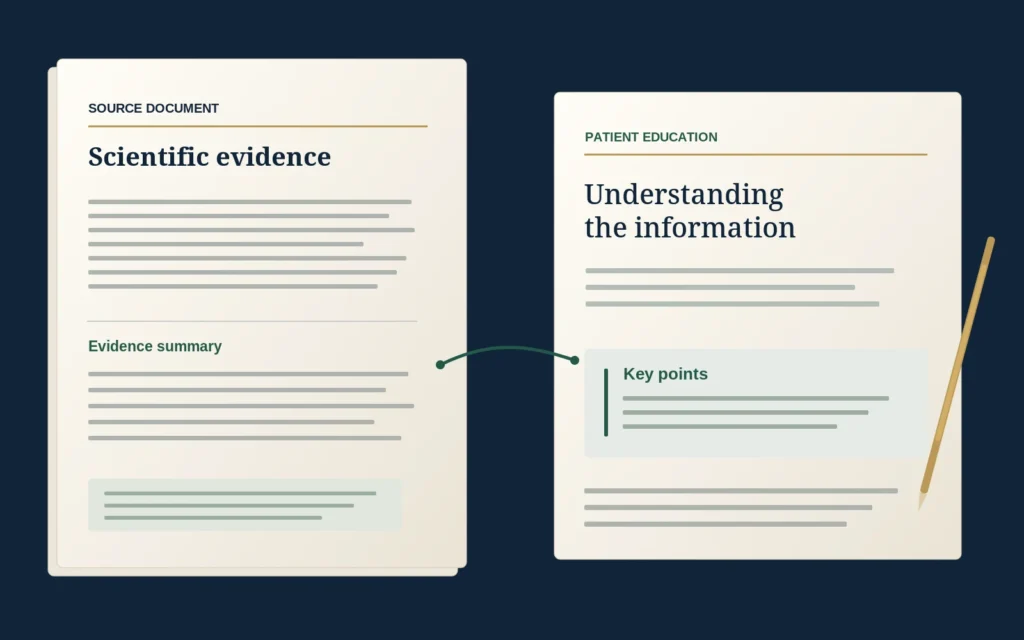
From Clinical Evidence to Clear Patient Education
Making clinical evidence easier to read is only the start. Explore how patient education can preserve qualifications, explain numbers, and serve a clear reader purpose.
Read article : From Clinical Evidence to Clear Patient Education
What to Include in a Medical Writing Brief
A topic, word count, and deadline are the beginning of a conversation. Use this practical guide to define the writing assignment before assumptions become revisions.
Read article : What to Include in a Medical Writing Brief