Checking Medical References: Does the Source Support the Claim?
A citation can be relevant without supporting the sentence beside it. A practical guide to matching medical claims with evidence and leaving a useful editorial decision.

Quick answer
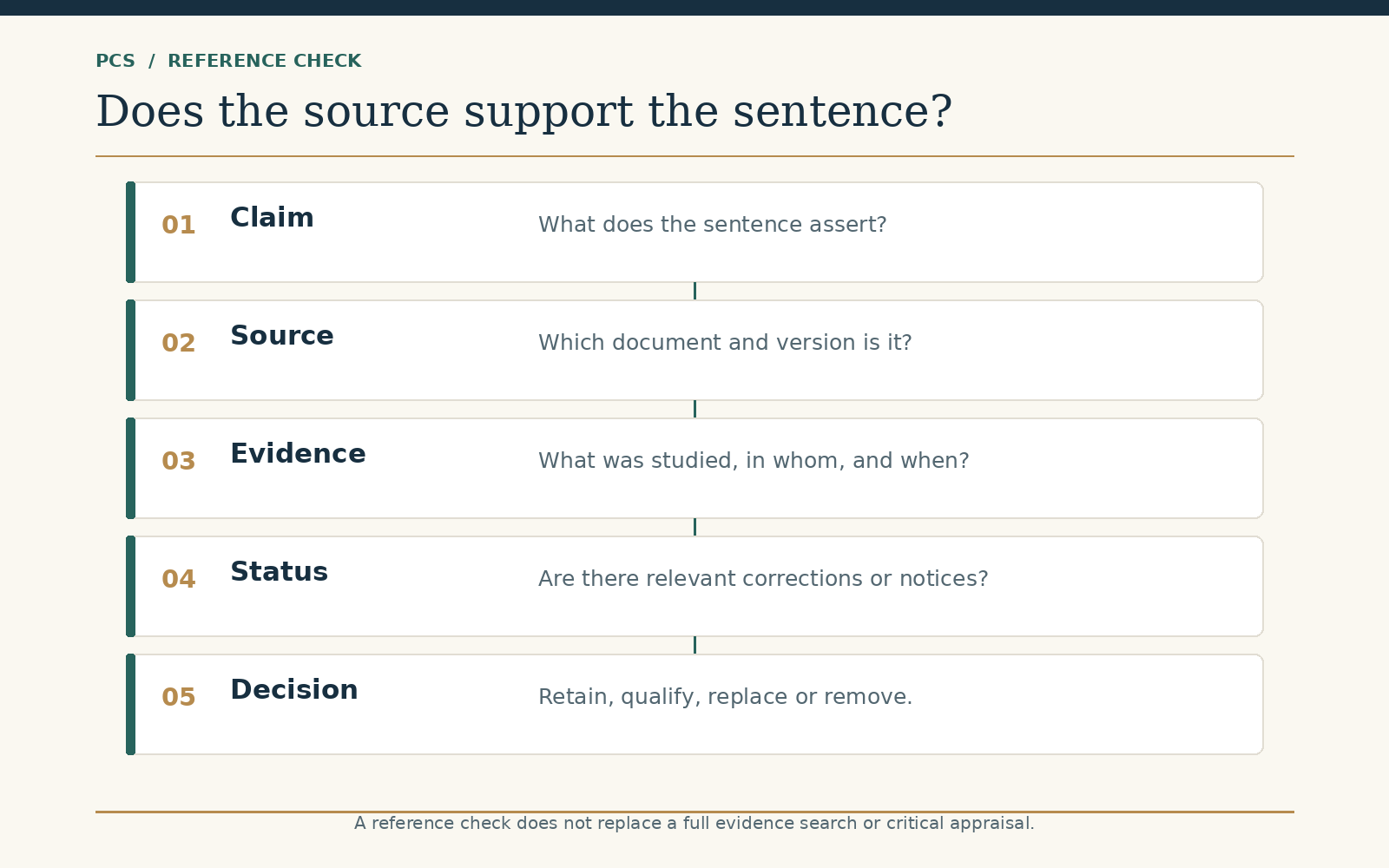
Checking medical references means identifying the exact claim, confirming the source and document type, reading the relevant material, comparing evidence boundaries with the wording, checking available correction or retraction notices, and documenting the result. Citation formatting alone does not establish support.
Checking medical references begins with a question that a tidy bibliography cannot answer: does this source support this particular sentence?
Picture an editor opening a draft with a reference after every paragraph. Nothing looks uncited. Then one sentence says an intervention “prevents complications.” The linked paper reports an association with a different outcome in a limited population.
The citation exists. The support does not extend as far as the sentence.
This is an illustrative editing scenario, not a report of a client project. It describes a useful distinction: locating a reference, understanding its findings, and deciding whether it supports the wording are separate tasks.
Start with the claim, not the reference list
Before opening the paper, identify what the sentence asks the reader to believe. Is it describing a frequency, explaining a mechanism, comparing treatments, reporting a study result, or making a recommendation?
A sentence can contain several claims under one citation. “This treatment is effective, well tolerated, and convenient” asks three different questions. One source might address only one of them.
Separate the claims before deciding whether they are supported. Otherwise, a relevant reference can lend an appearance of authority to words it never establishes.
For medication-specific examples, see common accuracy problems in medication content.
Confirm which source you are reading
Match the title, authors, publication, year, and identifying details. A DOI or PMID can help locate a record, but an identifier is not a finding and does not certify that the source is appropriate.
Also identify the document type. An original study, review, guideline, conference abstract, editorial, and preprint do not perform the same evidentiary job. A secondary article can orient a reader while leaving a specific claim dependent on a source it cites.
PubMed is not interchangeable with MEDLINE or PubMed Central. NLM describes PubMed as a broader citation resource, MEDLINE as a curated bibliographic component, and PMC as a full-text archive.[1] Finding a record is a discovery step, not a complete assessment of the article.
Read the material needed to assess the sentence
The title may sound right while the methods or results tell a narrower story. Open the relevant text, tables, figures, and supplements when available and necessary for the claim.
If only an abstract is available, state that limitation in the review record. Do not imply that the full methods, analyses, or supplementary material were checked.
ICMJE recommends that authors verify references against original sources or bibliographic databases and ensure they support the associated statements.[2] That principle is a useful foundation for reference checking beyond journal submissions.
For each important claim, leave a traceable location: a section heading, table number, page, or short note identifying the relevant result. The next person should not have to repeat the entire search to understand the edit.
Match the boundaries of the evidence
Ask what was studied, in whom, compared with what, and over which period. Then compare those details with the words on the page.
Did the article turn an outcome measured at follow-up into a claim about immediate benefit? Did a result for a subgroup become a statement about all participants? Did a discussion of a possible mechanism become an established explanation?
These questions do not make a study unhelpful. They establish the conditions under which it is useful for the sentence being written.
A practical check can use four notes:
- Claim: the exact wording under review.
- Support: the relevant finding and its location.
- Boundary: the qualification that changes interpretation.
- Action: retain, qualify, replace the source, or remove.
This is an editorial working method, not a validated appraisal instrument or a substitute for study-quality assessment.
Check the strength of the wording
Now look closely at the verbs. “Associated with,” “reduced,” “may help,” and “prevents” make different commitments. Choose language that reflects the study design, analysis, and result rather than the headline the team wishes it had.
Watch the nouns, too. A change in a measured marker is not automatically a change in a patient-important outcome. A statistically significant result is not, by that fact alone, an explanation of clinical importance.
Sometimes the useful edit is a narrower sentence. Sometimes the existing sentence needs a different source. If no appropriate support is available, keeping the reference while softening a few adjectives may still leave the central problem unresolved.
Check versions, corrections, and retractions
Record which version you assessed. Check the publisher’s page and available linked notices for corrections, expressions of concern, or retractions that may affect use of the source.
PubMed documents links between citations and associated notices, including errata, expressions of concern, and retractions.[3] Those links are useful checks, but the absence of a visible notice is not a guarantee that a finding is reliable.
A correction does not necessarily invalidate every part of a paper. Read what changed and determine whether it affects the claim. A retracted source should not be presented as ordinary supporting evidence; if discussed, its status must be explicit.
For claims about current recommendations, check the relevant current guidance as well. The newest paper and the guidance that applies to the article’s purpose are not automatically the same thing.
Leave a decision the editorial team can use
A useful reference check ends with a finding, not a pile of tabs. Explain what was checked, what the source supports, the proposed change, and anything that could not be resolved.
Consider this clearly invented example, without a real drug or study: the draft says, “The intervention prevents the outcome.” The available source reports an association in a selected population. A review note might recommend describing the association and population, or removing the claim if that no longer serves the article.
That is more useful than simply attaching another citation. It connects evidence to a publication decision.
Checking supplied references also has limits. It does not establish that all relevant studies were found, resolve every methodological concern, or amount to independent journal peer review. A broader search or critical appraisal needs its own scope.
The medical writing brief guide can help define those expectations. For the distinction between preparing copy and assessing its clinical claims, see writing, editing, and clinical review.
Frequently asked questions
Is checking medical references just checking citation formatting?
No. Formatting asks whether the reference is presented correctly. Claim-to-source checking asks whether the material supports what the article says. A project can include either or both; the guide to editorial and clinical services helps separate the work.
Can I rely on the abstract alone?
An abstract can help screen a source, but it may not contain what is needed to assess a detailed claim. Record when access was limited to the abstract and avoid presenting unchecked material as reviewed. If fuller evidence is needed, flag the gap.
Should every reference be an original study?
No. Choose the source for the claim. A guideline may support a recommendation; a review may help explain a body of evidence; an original study may be necessary for a specific reported result. The source’s relevance, quality, currency, and limits still need assessment.
Can PCS check the references in an existing draft?
You can request a scoped review of an existing draft and its supplied references. Specify whether you need claim-to-source checking, additional literature research, proposed edits, or a documented combination. See PCS project services for the inquiry pathway.
References
- National Library of Medicine. About PubMed
- International Committee of Medical Journal Editors. Preparing a Manuscript for Submission to a Medical Journal. References section.
- National Library of Medicine. PubMed User Guide. Comment Correction Type.
Publishing medical or medication content?
Request an annotated clinical review of accuracy, evidence support, and audience clarity.
More from the Review
Scroll or swipe to explore related articles. When the article list is focused, use the left and right arrow keys; Home and End jump to the beginning and end.

What a Useful Clinical Review Report Should Include
Clinical feedback is useful when the next decision is clear. Explore the scope, evidence, findings, proposed actions, and handoff a practical review report should contain.
Read article : What a Useful Clinical Review Report Should Include
Medical Literature Research: What a Targeted Review Can—and Cannot—Answer
A focused search can serve a useful purpose without being comprehensive. Understand what targeted literature research can answer, how to describe its limits, and when broader work is needed.
Read article : Medical Literature Research: What a Targeted Review Can—and Cannot—Answer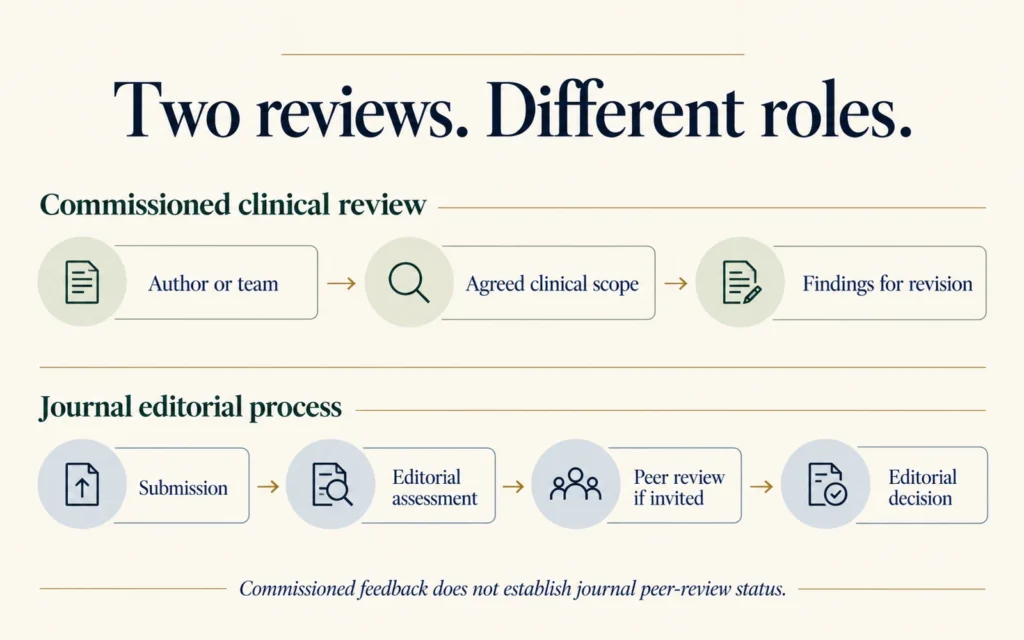
Clinical Manuscript Review vs. Journal Peer Review
A careful commissioned review can improve a manuscript without becoming journal peer review. Understand the roles, limits, and deliverables before choosing the service.
Read article : Clinical Manuscript Review vs. Journal Peer Review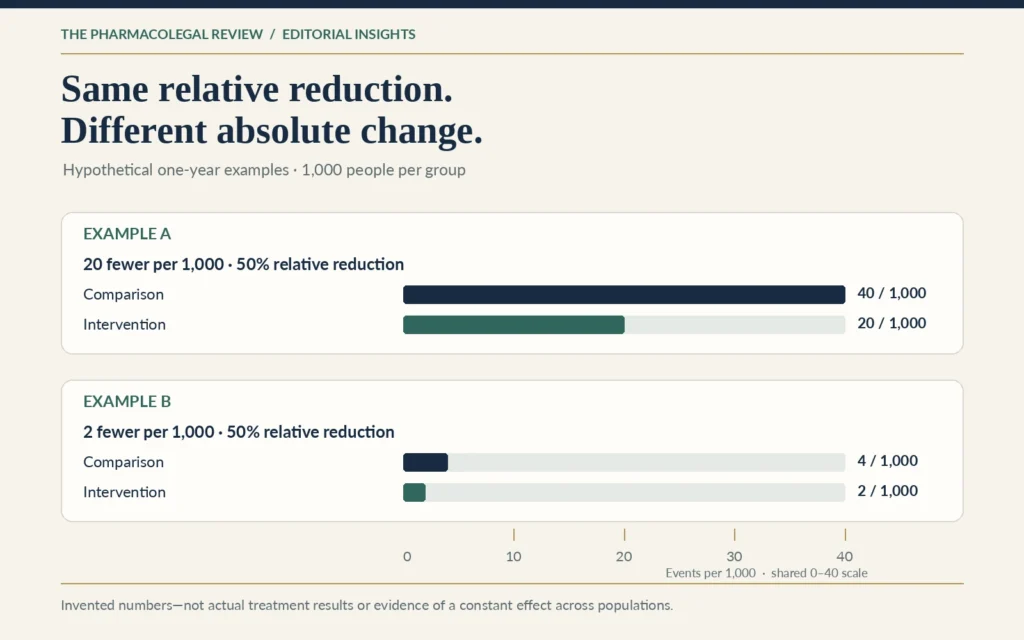
Understanding Absolute and Relative Risk in Medical Articles
A “50% reduction” needs a starting risk and a timeframe. Two clearly labeled hypothetical examples show how absolute and relative measures fit together—and where wording can mislead.
Read article : Understanding Absolute and Relative Risk in Medical Articles
Common Accuracy Problems in Medication Content
A polished medication article can still imply more than its evidence supports. Six practical review targets reveal where meaning can shift—and how to document a useful correction.
Read article : Common Accuracy Problems in Medication Content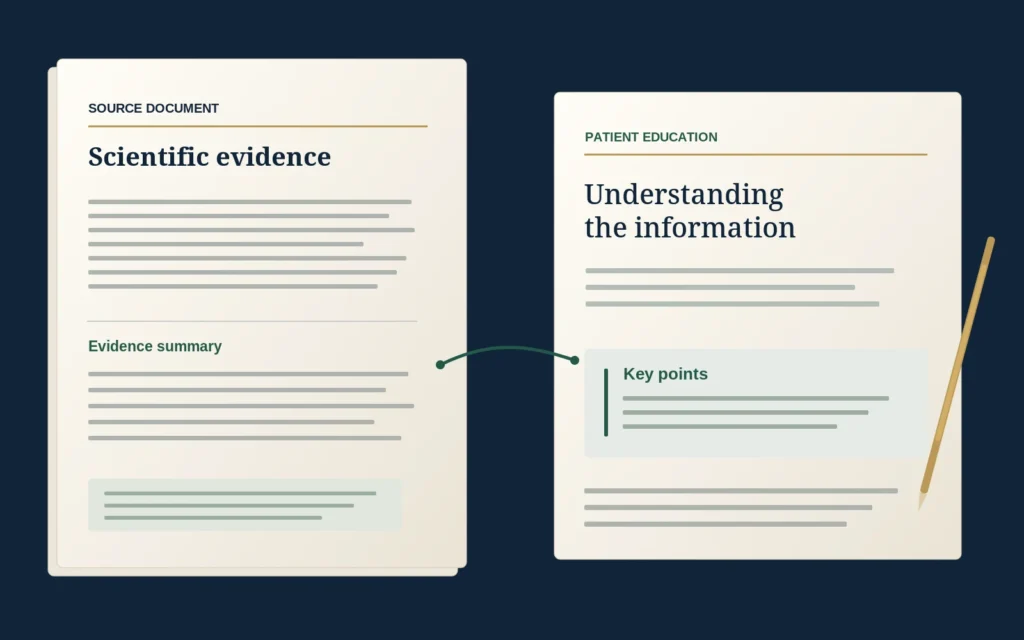
From Clinical Evidence to Clear Patient Education
Making clinical evidence easier to read is only the start. Explore how patient education can preserve qualifications, explain numbers, and serve a clear reader purpose.
Read article : From Clinical Evidence to Clear Patient Education