What a Useful Clinical Review Report Should Include
Clinical feedback is useful when the next decision is clear. Explore the scope, evidence, findings, proposed actions, and handoff a practical review report should contain.

Quick answer
A useful clinical review report identifies the draft and scope, summarizes important findings, links concerns to evidence, proposes actions, and records unresolved questions. It should distinguish clinical issues from stylistic preferences and state whether revised copy or final proofs will be rechecked.
Have a draft that needs a clinical review? Request a Review Quote ↗
A clinical review report should help an editorial team make decisions. It should show what was reviewed, where the concerns are, why they matter, and what needs to happen next.
Imagine receiving a draft with forty comments and a covering email that says, “Reviewed—please see notes.” One comment questions a claim. Another changes a comma. A third asks for a source. Which issues need resolving before publication?
The review may contain excellent observations. The handoff still leaves the team guessing.
This is an illustrative editorial scenario, not a description of a client engagement. In this article, “clinical review” means reviewing the clinical content of a publication or educational material—not assessing an individual patient’s care. The structure below is a proposed working approach, not a mandatory professional reporting standard.
Begin with the scope and the version reviewed
A useful report identifies the material precisely: title, filename or version, date received, and the components included. If the assignment covers the body copy but not the figures, say so. If references were supplied but additional literature searching was excluded, record that boundary.
List the questions the review was intended to address. Medication accuracy, claim-to-source support, suitability for an audience, and a full methodological appraisal are different assignments. A broad label such as “medical review” should not silently promise all four.
Record the intended reader and purpose, too. CDC’s Clear Communication Index begins with questions about audience, health literacy, communication objective, and main message.[1] Those details help distinguish a clinical concern from a choice that depends on who will read the piece.
The medical writing brief guide provides a useful place to establish these expectations before commissioning work.
Give the team a short findings summary
The opening summary should explain the substantive issues and the next decisions. It is not a miniature reproduction of every tracked change.
For example: “Two claims need source clarification; one figure omits a qualification; copyediting changes are recorded separately.” This invented example tells a project lead where attention is needed without pretending that the report provides universal publication clearance.
Avoid a single “approved” stamp unless the assignment explicitly defines who can approve what. “Review completed” describes a process. It does not, by itself, establish that every comment is resolved or that the final designed version has been checked.
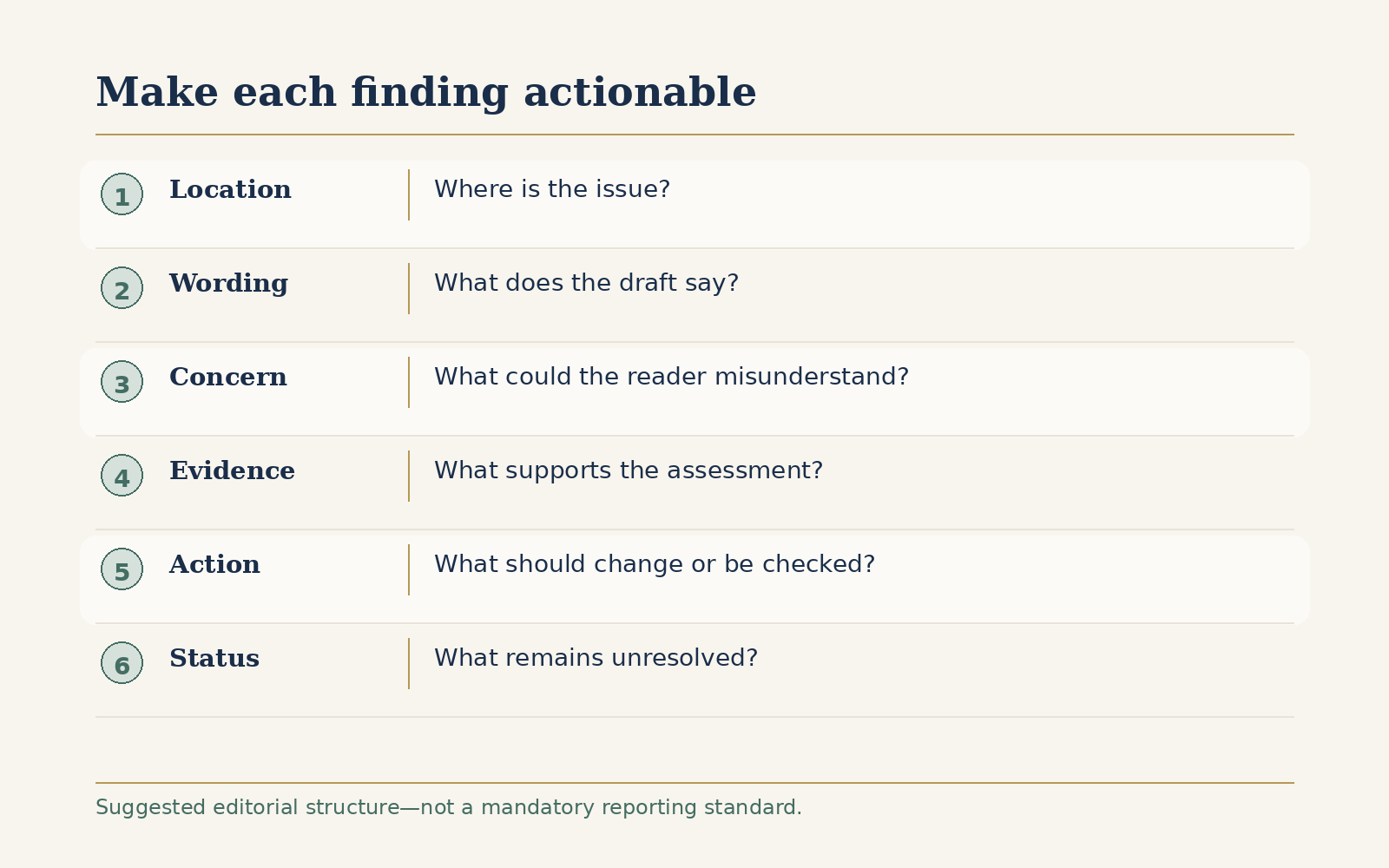
Make each clinical finding traceable
A useful finding connects the wording to the reasoning behind the concern. Give the writer enough detail to act without requiring another meeting to decode the comment.
- Location: section, paragraph, table, caption, or figure.
- Current wording: the exact claim or an identifiable extract.
- Concern: what the reader could understand incorrectly.
- Evidence: the supporting source and relevant passage, section, or table.
- Proposed action: a revision, qualification, different source, or question for further review.
- Status: unresolved, revised for recheck, or resolved against a named version.
ICMJE asks authors to ensure their references support the associated statements.[2] In an editorial report, showing the evidence-to-wording connection makes that principle useful to the person revising the text.
A citation alone is not an explanation. “The source reports an association; this sentence implies prevention” is a more actionable note than “Needs reference.” See how to check whether a medical reference supports a claim.
Distinguish clinical concerns from editorial preferences
Teams need a way to recognize consequential issues without turning every stylistic choice into an emergency.
Agree on a small set of labels. A project might separate a potential accuracy or safety concern, a source question, an audience-clarity issue, and a stylistic suggestion. These are practical project labels, not validated risk scores.
Explain the reason for the label. If a sentence could imply an instruction that the evidence does not support, describe that implication. If two phrasings are both acceptable and one is simply easier to read, say that instead.
Do not let a label replace the assessment. A large red heading cannot tell the team what to change, and a low-priority label should not obscure a substantive unresolved question.
Show the evidence and access limits
Record what was available and what was actually examined. Distinguish a supplied-source review from an additional search, and an abstract-level check from examination of the full article and relevant supplements.
When evidence is insufficient, make the gap visible. A report can recommend removing an unsupported claim, narrowing it, or commissioning further work. It should not fill the space with certainty the reviewer does not have.
If the assignment needs broader research, the guide to targeted medical literature research explains how search scope changes what a deliverable can answer.
What one useful finding can look like
Consider this invented example, which does not describe an actual medicine or study:
- Location: opening summary, second sentence.
- Draft claim: “The intervention prevents the outcome.”
- Concern: the supplied source describes an association in a defined population; the sentence asserts prevention without that boundary.
- Proposed action: describe the reported association and population if relevant to the article, or remove the claim.
- Next check: verify the revised sentence against the source before closing the finding.
The useful part is the chain of reasoning. It remains visible even if the team chooses a different final sentence.
Close with a usable handoff
Identify which decisions remain open, who will resolve them, and whether a recheck is included. Preserve a clean link between the report, revised draft, and final proof.
A revision can fix one sentence while leaving the original overstatement in a pull quote or graphic. Agree whether the reviewer will examine the designed material after revisions. Do not describe that step as completed if the assignment ended with the manuscript.
The final handoff might include an annotated draft and a short findings log. Another project may need a referenced memo. Format should follow the work; adding pages is not the same as adding value.
When requesting clinical content review, specify the draft stage, audience, source access, questions, desired output, and deadline. A clear deliverable makes it easier to scope the work and use the result.
Frequently asked questions
Does a clinical review report have to be a separate document?
No. An annotated draft plus a concise findings summary may suit the project. The important point is that concerns, evidence, actions, and open questions remain traceable. Agree on the format in the project brief.
Is this the same as journal peer review?
No. A commissioned content review has an agreed client scope. Journal peer review is part of a journal’s editorial process. Do not present one as the other; the service distinctions guide explains the scope of clinical review.
Should the report include rewritten copy?
Only if that is included in the assignment. Proposed corrections can make findings easier to use, but a complete rewrite is additional work. Specify whether you need comments, suggested wording, a findings log, or revised copy.
What should I send when requesting a review?
Provide the current draft, intended audience, supplied references, relevant visuals, deadline, and the questions you need answered. See PCS project services to prepare a scoped inquiry.
References
- Centers for Disease Control and Prevention. How to Use the Clear Communication Index.
- International Committee of Medical Journal Editors. Preparing a Manuscript for Submission to a Medical Journal. References section.
Have a draft that needs a clinical review?
Get annotated feedback on medication accuracy, source support, and clinical context. Send your topic, deliverable, and deadline to start a proposal.
More from the Review
Scroll or swipe to explore related articles. When the article list is focused, use the left and right arrow keys; Home and End jump to the beginning and end.

Medical Literature Research: What a Targeted Review Can—and Cannot—Answer
A focused search can serve a useful purpose without being comprehensive. Understand what targeted literature research can answer, how to describe its limits, and when broader work is needed.
Read article : Medical Literature Research: What a Targeted Review Can—and Cannot—Answer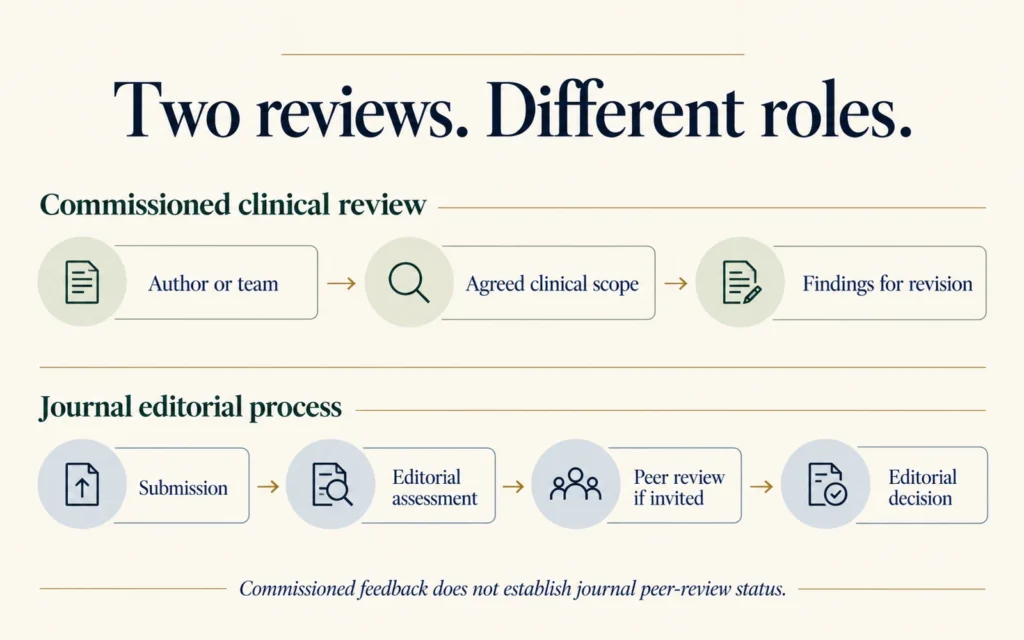
Clinical Manuscript Review vs. Journal Peer Review
A careful commissioned review can improve a manuscript without becoming journal peer review. Understand the roles, limits, and deliverables before choosing the service.
Read article : Clinical Manuscript Review vs. Journal Peer Review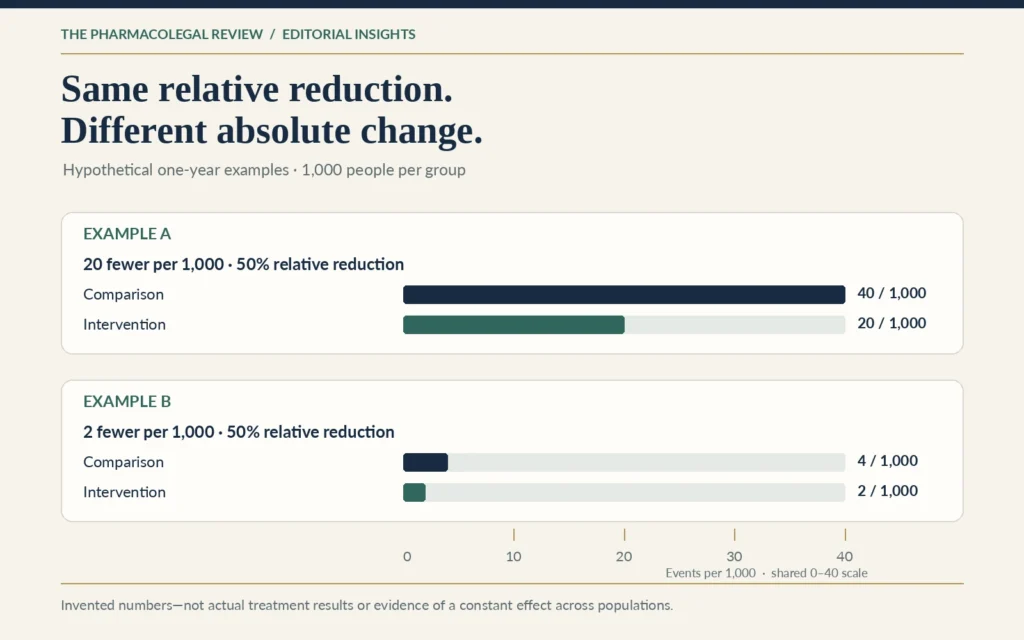
Understanding Absolute and Relative Risk in Medical Articles
A “50% reduction” needs a starting risk and a timeframe. Two clearly labeled hypothetical examples show how absolute and relative measures fit together—and where wording can mislead.
Read article : Understanding Absolute and Relative Risk in Medical Articles
Checking Medical References: Does the Source Support the Claim?
A citation can be relevant without supporting the sentence beside it. A practical guide to matching medical claims with evidence and leaving a useful editorial decision.
Read article : Checking Medical References: Does the Source Support the Claim?
Common Accuracy Problems in Medication Content
A polished medication article can still imply more than its evidence supports. Six practical review targets reveal where meaning can shift—and how to document a useful correction.
Read article : Common Accuracy Problems in Medication Content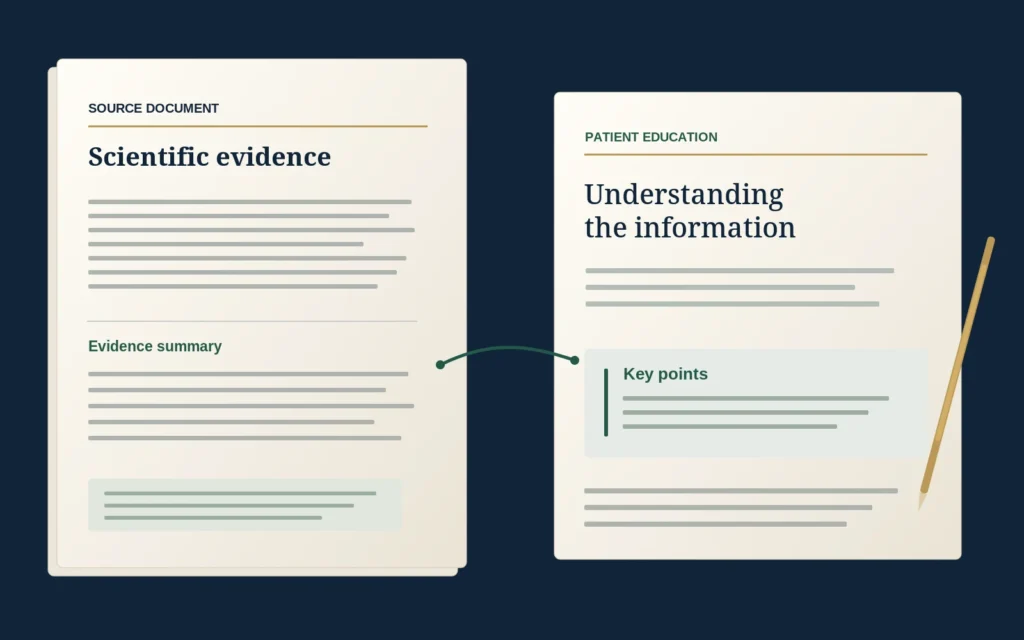
From Clinical Evidence to Clear Patient Education
Making clinical evidence easier to read is only the start. Explore how patient education can preserve qualifications, explain numbers, and serve a clear reader purpose.
Read article : From Clinical Evidence to Clear Patient Education