Medical Writing, Editing, and Clinical Review: Which Does Your Project Need?
“Please polish” can conceal three different assignments. Learn how writing, editing, and clinical review differ—and how to commission the work your document actually needs.
Quick answer
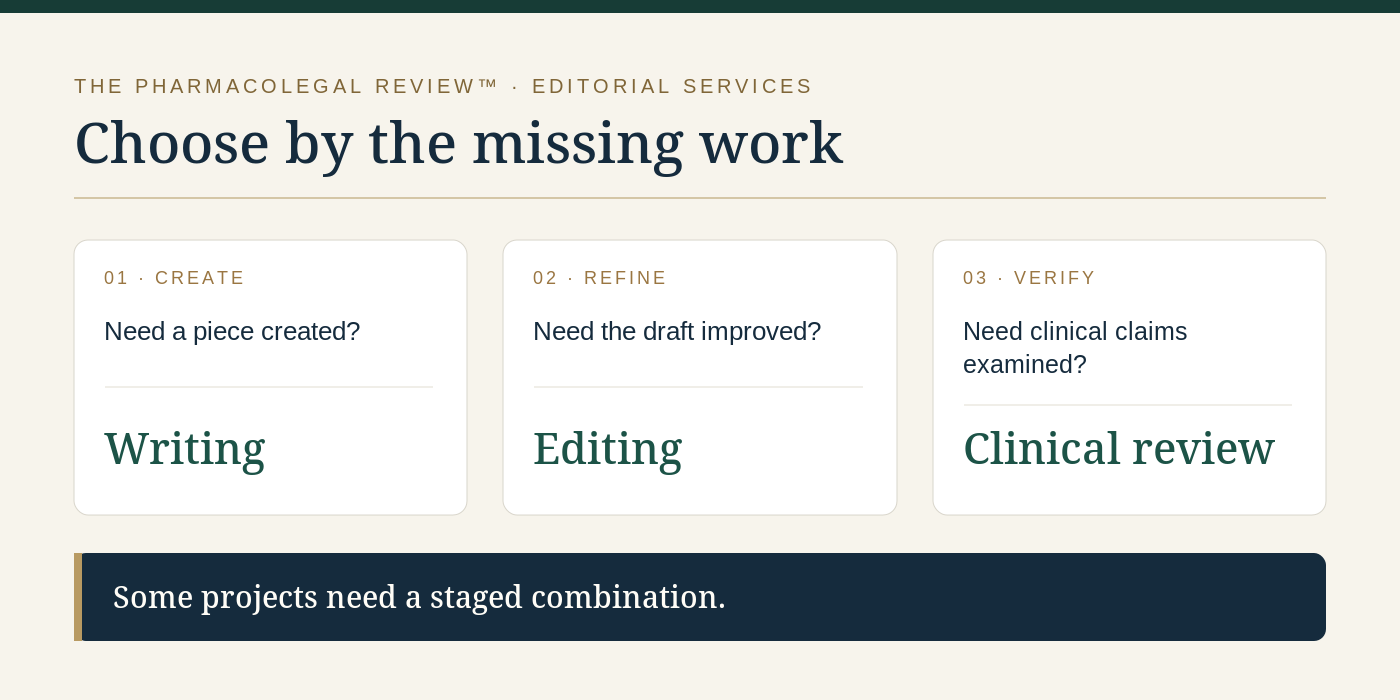
Medical writing creates content; editing improves an existing document at an agreed depth; clinical review assesses relevant clinical claims, evidence support, and context. Some projects need a combination. Define the deliverables and review responsibilities before commissioning the work.
Medical writing and editing serve different purposes from clinical review. Choosing between them becomes easier when you identify what your project is missing: the content itself, a clearer presentation, or a closer examination of its clinical claims.
Picture an editor opening a promising draft. The structure wanders, a medication statement needs checking, and the deadline is approaching. The brief says, “Please polish.”
That small instruction can conceal three different assignments.
One person may expect a complete rewrite. Another may expect punctuation fixes. A third may assume every reference will be verified. Before anyone starts polishing, the useful question is: What work are we actually commissioning?
Medical writing: build the piece
Medical writing creates content around a defined question, audience, and purpose. It can include research, outlining, drafting, reference selection, and revisions when those tasks are included in the brief.
A writing assignment might begin with a topic and source materials, rather than a finished manuscript. The writer decides how to organize the explanation and develops language that serves the intended reader.
The deliverable should be specific: for example, a referenced patient-education article or a physician-facing topic summary. “Healthcare content” is a subject area, not a sufficiently defined product.
It is equally important to say what is excluded. New interviews, extensive literature searching, publication submission, or additional versions for other audiences should not be assumed merely because the assignment involves writing.
Medical editing: improve the document you have
Editing works on existing material, but the depth can vary considerably. A structural edit may reorganize an argument or identify missing sections. A line edit may improve flow and expression. Copyediting may address consistency, grammar, terminology, and house style.
Those are useful distinctions, not a universal contract. Different providers use service labels differently. The scope should explain the actual tasks.
If the draft needs a new opening, a different argument, and substantial new research, calling the assignment “a quick copyedit” will not make the work smaller. It will make the expectations less clear.
Ask which changes will be made directly, which will be suggested, and which questions will return to the author. That makes feedback easier to interpret and revisions easier to plan.
Clinical review: examine what the content says
Clinical content review examines relevant factual statements, evidence support, qualifications, and clinical context within the reviewer’s expertise and agreed scope.
For medication-related material, a pharmacist’s review may examine product details, dosing statements, safety terminology, interactions, and the interpretation of supporting sources. The exact questions depend on the document and the engagement.
FDA’s explanation of prescription labeling illustrates the breadth of product information that may need checking, from indications and dosage to warnings and specific populations.[1] The relevant review still needs a defined purpose; no short article can reproduce every detail of a product label.
The result may be an annotated manuscript, proposed corrections, supporting references, and unresolved questions. Read more about what a pharmacist reviews in medical content.
Medical writing and editing: a practical comparison
| Your starting point | Likely need | Define the deliverable |
|---|---|---|
| A topic and an intended audience | Medical writing | A researched draft in the agreed format |
| A draft that needs stronger organization or language | Medical editing | A revised or annotated document at the agreed editing depth |
| Clinical statements that need assessment | Clinical content review | Findings, recommended corrections, and identified limitations |
| A document with several of these needs | A staged combination | Separate tasks, review points, and responsibilities |
This table is a commissioning guide, not a rule that every project must fit one column. A well-scoped engagement can combine services.
When the project needs more than one service
Consider an illustrative patient-information project with a rough draft, unclear structure, and medication claims that need verification. Editing the prose first might leave the team polishing statements that later need to be removed.
A more useful sequence could identify the material clinical issues, revise the structure and content, then check the affected final passages. Another project may need drafting before there is enough content to review. Choose the order around the actual risks and dependencies.
Who checks changes made after review? Who resolves conflicting comments? Who approves the finished version? A staged plan should answer those questions rather than treating “reviewed” as a permanent property of the document.
Do not confuse clinical review with journal peer review
An author-commissioned review does not become journal peer review simply because a qualified professional performed it.
ICMJE describes responsibilities within the journal submission and peer-review process, including the editor’s role in assessing reviewer recommendations.[2] That context differs from a client commissioning help with a draft.
Describe the work accurately: the subject, scope, reviewer’s role, and deliverable. A clear description is more useful than borrowing a label from a different process.
Before you ask for a quote
Send the document or describe what exists. Identify the audience, desired outcome, deadline, reference requirements, and the work you expect. Note any final approval or confidentiality arrangements that need discussion.
If you are uncertain about the service, describe the problem: “We have a patient article that reads well, but we need the medication claims checked.” That is a far more useful starting point than selecting a label you hope covers everything.
Explore medical writing, clinical content review, and research and manuscript support to compare the available scope.
Frequently asked questions
Can the same professional write and review the content?
Yes, when the scope and expertise fit. That does not make the review independent of the writing. If an independent second assessment is required, specify that requirement and the appropriate reviewer arrangements.
Does medical editing include checking every clinical claim?
Not automatically. Ask whether the engagement includes substantive fact-checking, which sources will be consulted, and whether every reference or selected claims will be checked. Compare clinical review deliverables.
What if the draft needs substantial new research?
Identify that work before agreeing on the edit. New literature searching and evidence synthesis may require a separate research scope, additional time, or a combined assignment.
Does a clinical review guarantee publication or acceptance?
No. A review provides findings within its agreed scope. Journal acceptance and an organization’s publication approval remain separate decisions. See the editorial standards and review boundaries.
References
- U.S. Food and Drug Administration. How Do I Use Prescription Drug Labeling.
- International Committee of Medical Journal Editors. Responsibilities in the Submission and Peer-Review Process.
More from the Review
Scroll or swipe to explore related articles. When the article list is focused, use the left and right arrow keys; Home and End jump to the beginning and end.

Common Accuracy Problems in Medication Content
A polished medication article can still imply more than its evidence supports. Six practical review targets reveal where meaning can shift—and how to document a useful correction.
Read article : Common Accuracy Problems in Medication Content
From Clinical Evidence to Clear Patient Education
Making clinical evidence easier to read is only the start. Explore how patient education can preserve qualifications, explain numbers, and serve a clear reader purpose.
Read article : From Clinical Evidence to Clear Patient Education
What to Include in a Medical Writing Brief
A topic, word count, and deadline are the beginning of a conversation. Use this practical guide to define the writing assignment before assumptions become revisions.
Read article : What to Include in a Medical Writing Brief
Writing Medical Articles for Physicians and Patients: What Changes?
The same evidence can serve different readers without becoming the same article. Explore how audience changes structure, terminology, and clinical explanation.
Read article : Writing Medical Articles for Physicians and Patients: What Changes?
What Does a Pharmacist Review in Medical Content?
A polished sentence can still need a clinical correction. Explore what a pharmacist reviews in medical content, how useful feedback looks, and what a client should receive.
Read article : What Does a Pharmacist Review in Medical Content?
Checking Medical References: Does the Source Support the Claim?
A citation can be relevant without supporting the sentence beside it. A practical guide to matching medical claims with evidence and leaving a useful editorial decision.
Read article : Checking Medical References: Does the Source Support the Claim?Put the perspective to work.
Commission medical writing, request clinical content review, or scope a focused research project.