What Does a Pharmacist Review in Medical Content?
A polished sentence can still need a clinical correction. Explore what a pharmacist reviews in medical content, how useful feedback looks, and what a client should receive.

Quick answer
A pharmacist reviewing medication-related medical content examines drug information, clinical context, safety statements, supporting references, and audience clarity. Depending on the scope, the review may include dosing, interactions, study interpretation, missing qualifications, and recommendations for correction or further verification.
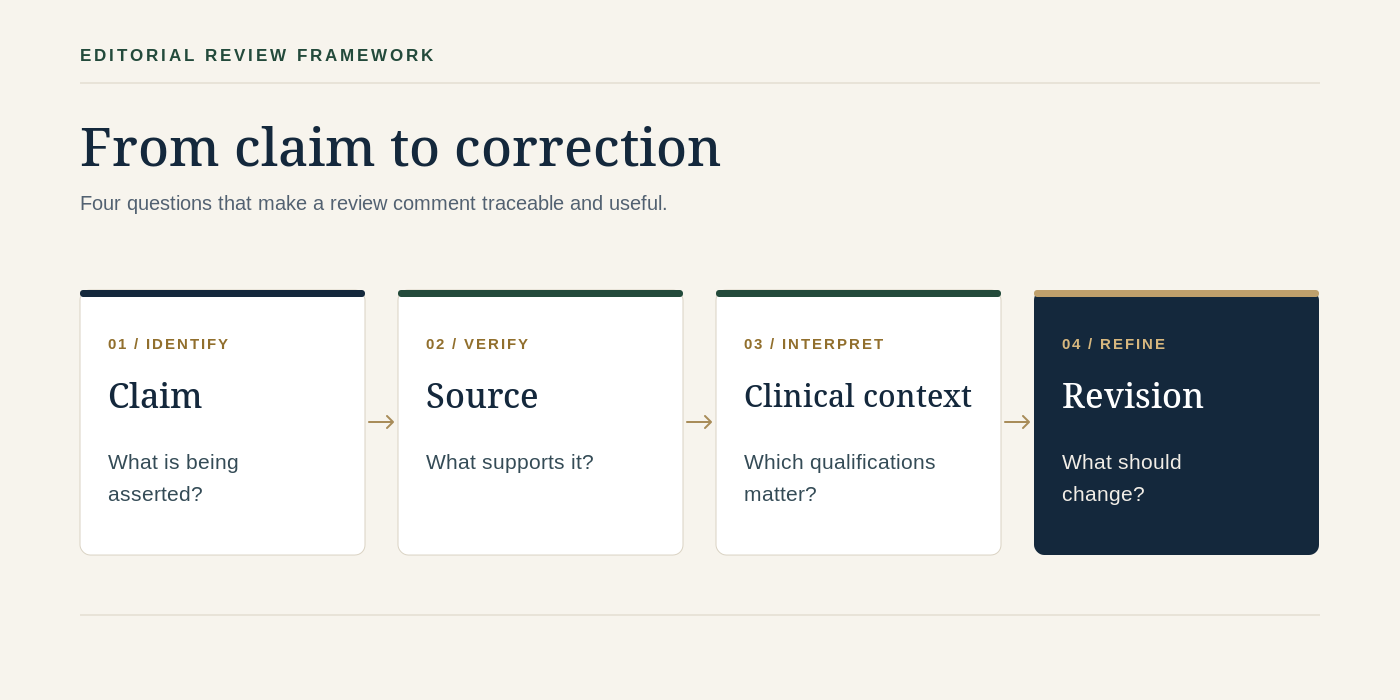
A pharmacist review of medical content examines whether medication claims are accurate, supported, and clear to the intended reader. The work starts with a simple question: what does this sentence ask someone to believe?
The draft looks ready. The headline is clear, the paragraphs move, and the references are neatly numbered. Then someone asks a small question: Does that study actually support this sentence?
That is where a different kind of editing begins.
A pharmacist reviewing medical content looks at the medication information beneath the polished language: what the claim means, which evidence supports it, and what a reader might reasonably take away. A sentence can read beautifully and still need a clinical correction.
For editors and healthcare teams, the value is a clearer understanding of what needs changing—and why—before the content reaches its audience.
A pharmacist review starts with the claim
Imagine a draft that says a medicine is “safe and effective for older adults.” A reference follows. So far, so reassuring.
Now ask: Which medicine and formulation? For which condition? Who was included in the research? What does “safe” mean here? Does the evidence support this broad statement, or a narrower finding?
This is an illustrative editorial scenario, not a description of a particular medicine. It shows why a citation is the beginning of a check, rather than the end of one.
A useful review follows the claim back to its source and then returns to the sentence. If the evidence is narrower than the wording, the wording needs attention.
Medication details: the small words carry weight
In medication content, a qualification can do a great deal of work. A route, formulation, population, or condition of use may be essential to understanding a statement.
For U.S. prescription-drug information, current prescribing information provides an important reference point. FDA describes sections covering indications, dosage, contraindications, warnings, interactions, and specific populations. It also explains that the Highlights summarize the full prescribing information and should not be used alone.[1]
Depending on the project, a pharmacist may examine:
- Identity: Is the correct drug, strength, formulation, and route being discussed?
- Use: Is the indication described accurately, with relevant distinctions between approved and other uses?
- Dosing: Have necessary conditions or population-specific qualifications been retained?
- Safety: Are warnings, contraindications, adverse reactions, and interaction statements represented precisely?
- Currency: Is the source version appropriate for the claim and publication date?
The goal is not to squeeze the entire prescribing document into a 700-word article. It is to recognize which missing detail could change the meaning of those 700 words.
Read the evidence at the same resolution as the sentence
“The study found an improvement” and “the treatment improves health” are not interchangeable claims.
A review can examine the population, intervention, comparator, measured outcome, timeframe, and limitations relevant to the statement. Was the reported finding the outcome the article describes? Does the design support a causal conclusion? Has a result from one setting been stretched into a general recommendation?
These questions require judgment. Replacing every confident verb with “may” is not evidence appraisal. Sometimes the sentence needs a qualification. Sometimes it needs a different source. Sometimes it needs to come out.
Make the meaning clear for the person reading
A patient looking for an understandable explanation and a physician evaluating a clinical summary bring different needs to the same topic.
CDC’s Clear Communication Index is a research-based tool for developing and assessing public communication.[2] Its guidance begins by identifying the audience, communication objective, and main message.[3] Those questions are a useful starting point for a content brief, too.
A reviewer can consider whether necessary terms are explained, whether numerical statements have enough context, and whether the article makes its purpose easy to follow. Shorter words help only when the underlying meaning survives.
For professional audiences, clarity may mean keeping a necessary technical term and explaining a study limitation more precisely. For patient audiences, it may mean unpacking that term and making the relevant qualification easier to recognize.
What an actionable review comment looks like
Consider this invented example:
“This medicine is safe for everyone.”
A useful comment would identify the unrestricted safety claim, explain what is missing, and specify what must be checked before a replacement can be written.
Review comment: “This wording makes an unrestricted safety claim. Please verify the relevant product information and supporting evidence, identify the intended population and conditions of use, and revise accordingly. The current source does not establish the statement as written.”
That is more helpful than “Please check safety.” It gives the editor something to resolve. A reviewer should not invent a corrected clinical statement when the necessary evidence has not yet been established.
What should a client receive?
The deliverable should make decisions easier. Depending on the agreed scope, that might include an annotated manuscript, proposed revisions, references supporting corrections, and a short list of unresolved questions.
A well-defined review distinguishes factual errors from requests for clarification and editorial preferences. It also identifies material that needs a different specialist or falls outside the engagement.
Before work begins, agree on:
- The intended audience, purpose, and document version.
- The medication-related subjects and claims to be assessed.
- The expected sources and depth of reference verification.
- The deliverable, deadline, and revision arrangements.
- Who will implement changes and approve the final content.
That last point matters. A review of version three does not establish that a new statement added in version five has been checked.
What the review does—and does not—establish
A pharmacist’s editorial review can contribute medication-focused analysis when the subject fits the reviewer’s expertise. It does not automatically constitute journal peer review, regulatory approval, or a guarantee that every error has been found.
Ask what was reviewed, which sources were used, and what remains unresolved. Those answers are more useful than an impressive-sounding review label without an explanation of the work behind it.
The practical aim is a piece whose claims are supportable, whose qualifications are visible, and whose language serves the reader. Good clinical review makes that standard easier to act on.
Preparing content for publication? Explore clinical content review deliverables and learn about the pharmacy background behind the practice.
Frequently asked questions
Is pharmacist review the same as medical copyediting?
The services can overlap, but the agreed emphasis differs. Copyediting may focus on language, consistency, and editorial style. A pharmacist’s clinical review focuses on medication-related accuracy, context, and evidence support within the reviewer’s expertise. Clarify the deliverable rather than relying on the service title alone. Compare writing and clinical review services →
Can a pharmacist review content someone else has written?
Yes, where the subject and scope are appropriate. Supply the draft, intended audience, source material, and specific concerns. An annotated review can identify changes for the author or editorial team to consider. Explore what a clinical content review can include →
Does every reference get checked?
Only if that work is included in the scope. Checking selected medication claims is different from verifying every citation throughout a manuscript. Agree on the extent of reference checking before the review begins. Explore reference verification and research support →
Does a review mean the article is approved for publication?
A review provides findings and recommendations under the agreed brief. Publication approval remains a separate responsibility unless a specific approval role has been expressly agreed. Later edits may require further review. Read more about review scope and editorial standards →
What determines the cost of a clinical content review?
Relevant factors include length, complexity, subject matter, reference-checking depth, turnaround, and the expected deliverable. A draft and clear brief allow those requirements to be assessed before a proposal is prepared. Discuss your review requirements with PharmacoLegal →
References
- U.S. Food and Drug Administration. How Do I Use Prescription Drug Labeling.
- Centers for Disease Control and Prevention. The CDC Clear Communication Index.
- Centers for Disease Control and Prevention. How to Use the Index.
More from the Review
Scroll or swipe to explore related articles. When the article list is focused, use the left and right arrow keys; Home and End jump to the beginning and end.

Common Accuracy Problems in Medication Content
A polished medication article can still imply more than its evidence supports. Six practical review targets reveal where meaning can shift—and how to document a useful correction.
Read article : Common Accuracy Problems in Medication Content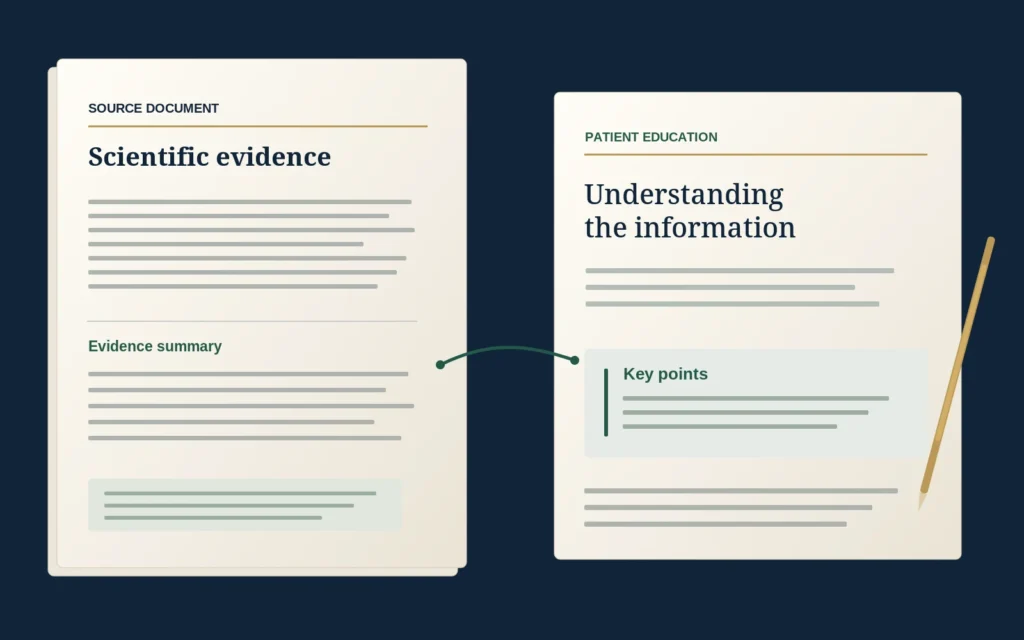
From Clinical Evidence to Clear Patient Education
Making clinical evidence easier to read is only the start. Explore how patient education can preserve qualifications, explain numbers, and serve a clear reader purpose.
Read article : From Clinical Evidence to Clear Patient Education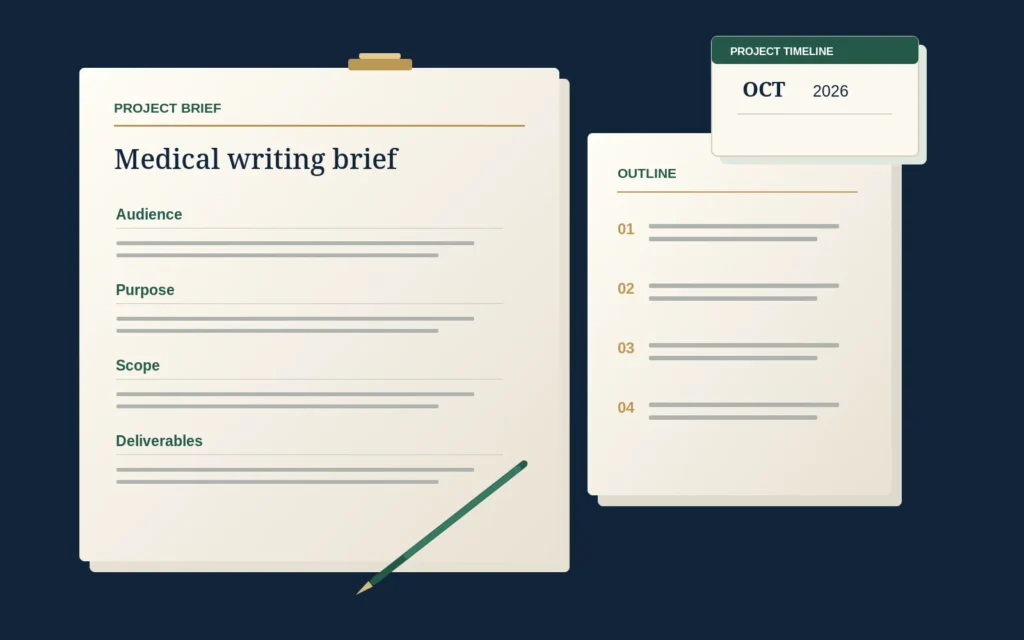
What to Include in a Medical Writing Brief
A topic, word count, and deadline are the beginning of a conversation. Use this practical guide to define the writing assignment before assumptions become revisions.
Read article : What to Include in a Medical Writing Brief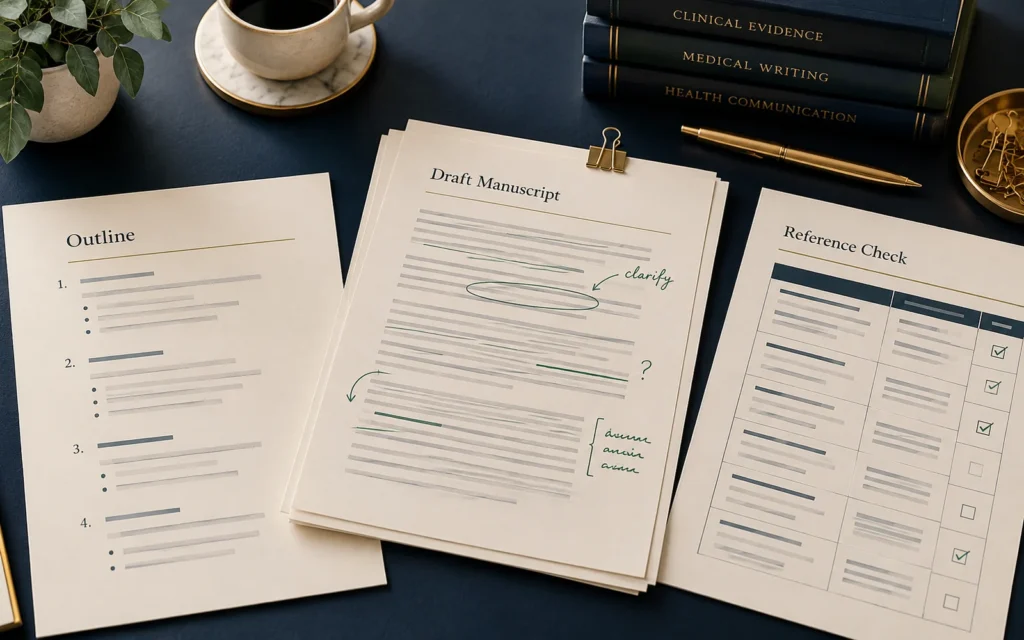
Medical Writing, Editing, and Clinical Review: Which Does Your Project Need?
“Please polish” can conceal three different assignments. Learn how writing, editing, and clinical review differ—and how to commission the work your document actually needs.
Read article : Medical Writing, Editing, and Clinical Review: Which Does Your Project Need?
Writing Medical Articles for Physicians and Patients: What Changes?
The same evidence can serve different readers without becoming the same article. Explore how audience changes structure, terminology, and clinical explanation.
Read article : Writing Medical Articles for Physicians and Patients: What Changes?
Checking Medical References: Does the Source Support the Claim?
A citation can be relevant without supporting the sentence beside it. A practical guide to matching medical claims with evidence and leaving a useful editorial decision.
Read article : Checking Medical References: Does the Source Support the Claim?Publishing medical or medication content?
Request an annotated clinical review of accuracy, evidence support, and audience clarity.