Medical Literature Research: What a Targeted Review Can—and Cannot—Answer
A focused search can serve a useful purpose without being comprehensive. Understand what targeted literature research can answer, how to describe its limits, and when broader work is needed.

Quick answer
Targeted medical literature research can identify and summarize evidence for a defined question within agreed sources, dates, and selection methods. It cannot guarantee completeness or replace a systematic review, individual clinical judgment, or a regulatory or legal determination. The deliverable should make methods, limitations, and unresolved questions explicit.
Need evidence for a defined question? Discuss Your Research Question ↗
Medical literature research becomes more useful when the question and the limits are clear before the search starts. A targeted review can address a defined information need. It cannot promise that every relevant study has been found or that uncertainty has disappeared.
Picture a team preparing an educational article. The request sounds simple: “Can you find the evidence on this?” One person wants background references. Another expects an assessment of conflicting findings. A third assumes the answer will support a particular recommendation.
They have asked for different projects under the same label.
This is an illustrative commissioning scenario, not a client account. Here, “targeted review” means a deliberately scoped literature project. The term alone does not specify a universal method, a systematic review, or a formal rapid-review process.
Define the question medical literature research needs to answer
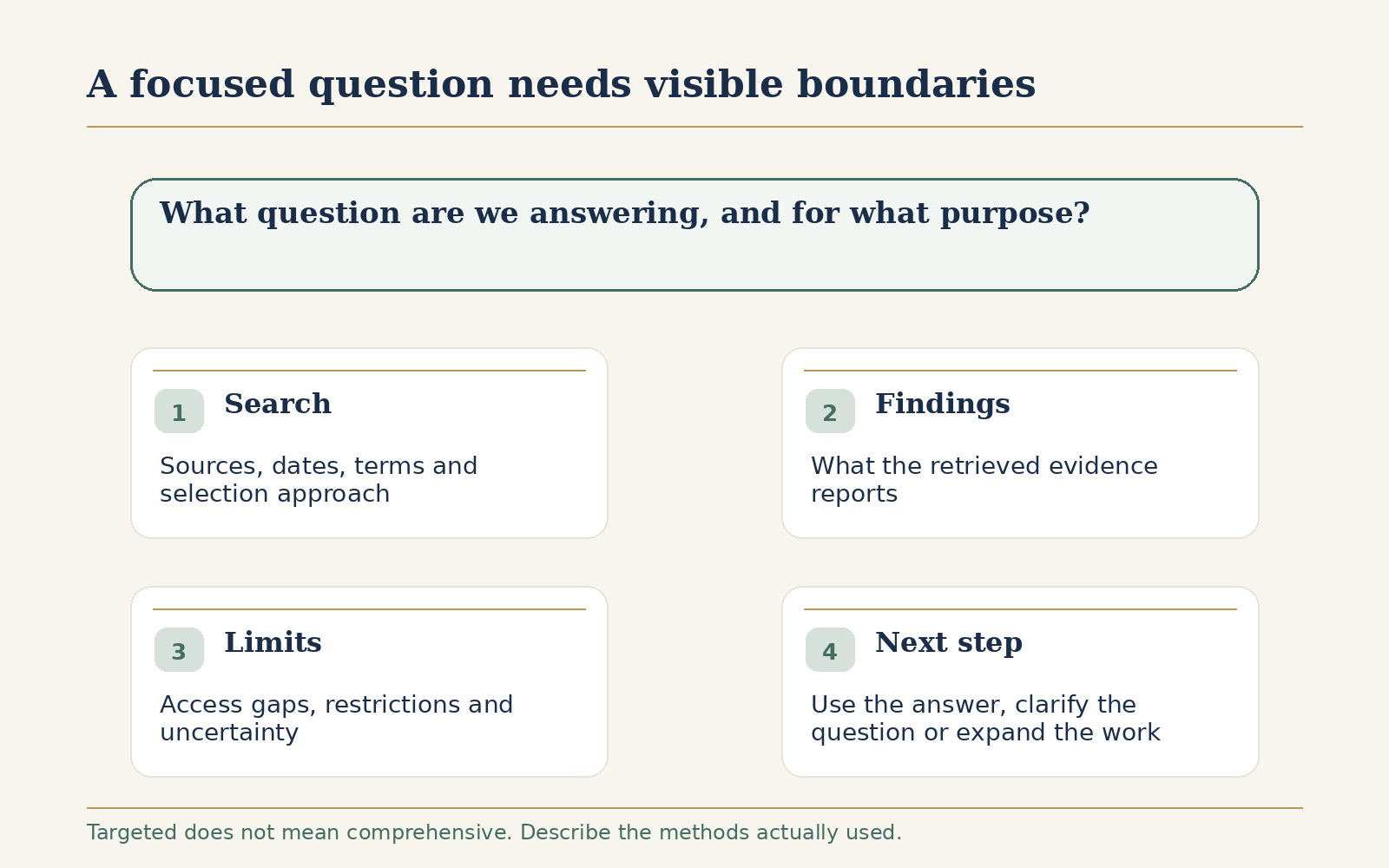
Start with the intended use. Is the team checking a narrow factual statement, developing a background section, exploring a clinical question, or deciding whether a larger evidence synthesis is needed?
Then define the population, intervention or exposure, comparison where relevant, outcomes, and setting. Not every question fits the same framework, but an explicit question is more useful than a topic with no boundaries.
For an educational project, a reasonable request might be to identify and summarize selected evidence relevant to a defined treatment concept. That is different from determining the best treatment for an individual or establishing a comprehensive recommendation.
The medical writing brief guide can help turn the request into an agreed assignment.
What a targeted review can usefully provide
Depending on the scope, a deliverable can identify relevant sources, summarize their findings, compare the populations and outcomes they describe, and highlight disagreements or gaps.
It can also distinguish questions that the retrieved material addresses from questions that remain unresolved. A useful summary need not end with a simple yes or no. “These sources answer a narrower question” may be the finding the client most needs.
Specify whether the work includes retrieval alone, narrative synthesis, structured extraction, critical appraisal, or an assessment of certainty. Those are distinct tasks; none should be assumed because the report contains references.
Make the search scope visible
Record the sources searched, search date, strategy or terms, relevant limits, and the approach to selecting material. Explain any restrictions on date, language, document type, access, or number of records assessed.
PubMed’s user guide describes how searches, field tags, filters, and other tools affect retrieval.[1] A search is a set of choices, not a neutral window that reveals everything on a topic.
A narrow search can be appropriate to a narrow assignment. The problem arises when its findings are presented as if they came from a comprehensive search of all relevant evidence.
Document supplied sources separately from newly retrieved sources. If the starting material was selected by the commissioning team, that is part of the project’s context, not an invisible detail.
Do not borrow the authority of a different review type
A targeted review should be named and described according to its actual methods. A shorter deadline does not, by itself, make it a formal rapid review. A spreadsheet and a flow diagram do not, by themselves, make it systematic.
Cochrane’s guidance for systematic intervention reviews describes a thorough, reproducible search across appropriate sources, with attention to minimizing bias.[2] That is a different methodological commitment from a limited search commissioned for a specific editorial question.
PRISMA is reporting guidance for systematic reviews; its main 2020 guideline focuses primarily on reviews of intervention effects.[3] Using a checklist or diagram does not retrospectively establish that the work met the required methods.
A modestly scoped report with an honest methods note is more useful than an ambitious label the project cannot support.
What the review cannot establish on its own
A targeted review does not guarantee completeness. Missing evidence can reflect the search scope, indexing, publication practices, unavailable full text, or a question that existing studies have not adequately addressed.
“No relevant studies were identified within this search” is different from “no studies exist.” Likewise, finding no clear evidence of a benefit is not automatically evidence that the benefit is absent.
The review also cannot make unlike studies directly comparable simply by placing them in one table. Differences in population, design, comparator, outcome definitions, follow-up, and limitations still matter.
Do not interpret the number of papers as the number of independent studies without checking. One study may produce multiple reports; Cochrane explicitly distinguishes studies from their reports.[2]
A literature summary can inform a decision. It does not replace individualized clinical judgment, a regulatory determination, or a legal conclusion.
Ask for a deliverable that shows the reasoning
A useful evidence summary can combine a short answer, methods note, source table, interpretation, limitations, and unresolved questions. The detail should match the stakes and intended use.
For each included source, identify why it was included, what it reports, and the limitation most relevant to the project question. Keep a source’s finding distinct from the reviewer’s interpretation.
If only an abstract was accessible, say so. If a conclusion depends on a document that could not be obtained, flag that dependency instead of smoothing it away.
Before a source becomes support for publication copy, check the exact wording against it. The medical reference-checking guide explains that additional step. The clinical review report guide shows how to document findings and proposed actions.
Recognize when the question needs a larger project
A broader synthesis may be appropriate when the decision depends on comprehensive identification, formal appraisal, conflicting evidence, or a defensible account of how evidence was selected and combined.
The next step may involve a medical librarian or information specialist, additional databases, a defined protocol, subject-matter expertise, or a specialist methods team. The choice depends on the question; it should not be decided by the length of the requested report.
For an initial inquiry, state the question, intended use, timeframe, existing sources, access constraints, and expected output. PCS literature research services can be scoped around that information, with the methods and limits made explicit.
The strongest outcome is an answer the reader can use without having to guess how much confidence the search deserves.
Frequently asked questions
Is medical literature research the same as a systematic review?
No. Medical literature research is a broad activity. A systematic review has a defined methodological approach; a targeted project should describe its actual methods and limits rather than imply systematic-review completeness.
Can a targeted review use only supplied references?
Yes, if the scope is explicitly a review of supplied material. That is different from an independent literature search. Agree on the source set, questions, and additional-search expectations in the project brief.
What if the search finds very little?
Report what was searched and the limits before drawing a conclusion. A low yield may justify revising the question or search, obtaining additional access, or commissioning broader work. It does not establish that relevant evidence does not exist.
What should I request from a literature research consultant?
Specify the question, purpose, scope, deadline, and deliverable. Ask how search methods, findings, limitations, and unresolved questions will be documented. Explore PCS project services to prepare the inquiry.
References
- National Library of Medicine. PubMed User Guide.
- Lefebvre C, et al. Chapter 4: Searching for and Selecting Studies. Cochrane Handbook for Systematic Reviews of Interventions. Updated March 2025.
- PRISMA. PRISMA Statement.
Need evidence for a defined question?
Request a targeted literature search and a referenced summary of the findings. Send your topic, deliverable, and deadline to start a proposal.
More from the Review
Scroll or swipe to explore related articles. When the article list is focused, use the left and right arrow keys; Home and End jump to the beginning and end.

What a Useful Clinical Review Report Should Include
Clinical feedback is useful when the next decision is clear. Explore the scope, evidence, findings, proposed actions, and handoff a practical review report should contain.
Read article : What a Useful Clinical Review Report Should Include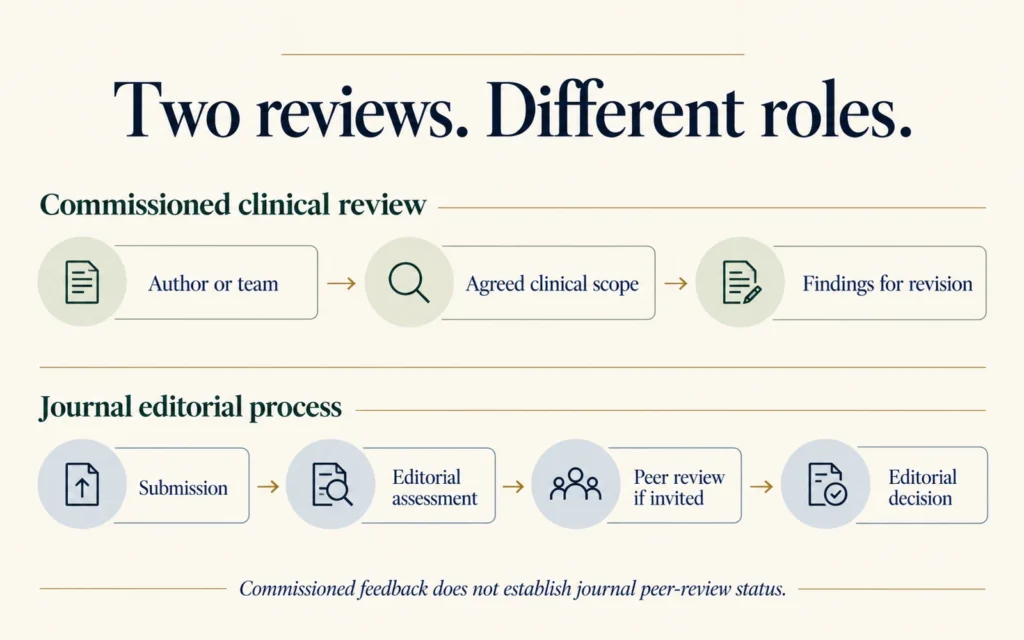
Clinical Manuscript Review vs. Journal Peer Review
A careful commissioned review can improve a manuscript without becoming journal peer review. Understand the roles, limits, and deliverables before choosing the service.
Read article : Clinical Manuscript Review vs. Journal Peer Review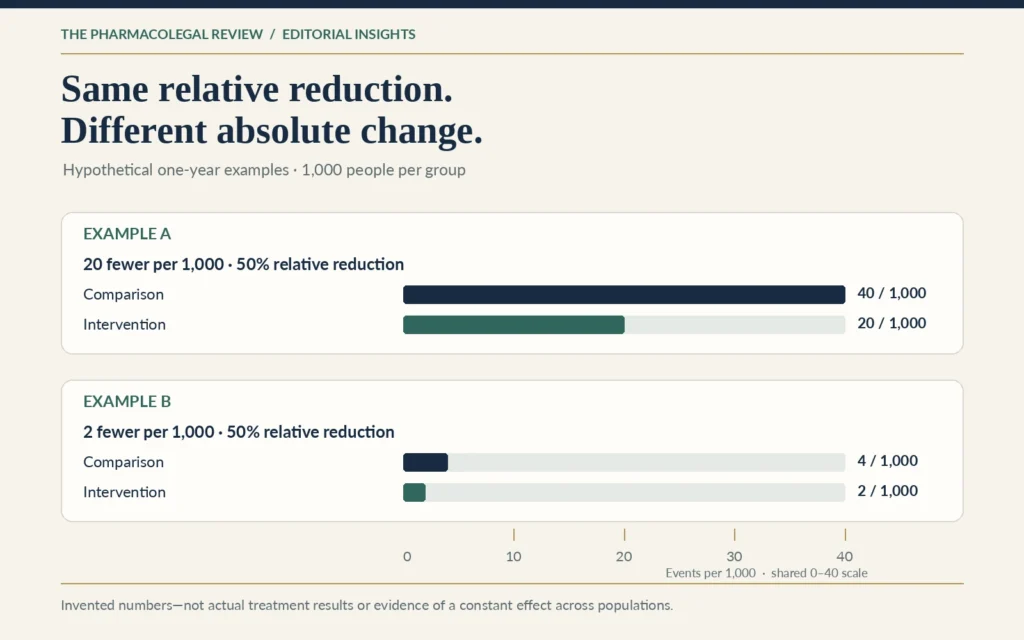
Understanding Absolute and Relative Risk in Medical Articles
A “50% reduction” needs a starting risk and a timeframe. Two clearly labeled hypothetical examples show how absolute and relative measures fit together—and where wording can mislead.
Read article : Understanding Absolute and Relative Risk in Medical Articles
Checking Medical References: Does the Source Support the Claim?
A citation can be relevant without supporting the sentence beside it. A practical guide to matching medical claims with evidence and leaving a useful editorial decision.
Read article : Checking Medical References: Does the Source Support the Claim?
Common Accuracy Problems in Medication Content
A polished medication article can still imply more than its evidence supports. Six practical review targets reveal where meaning can shift—and how to document a useful correction.
Read article : Common Accuracy Problems in Medication Content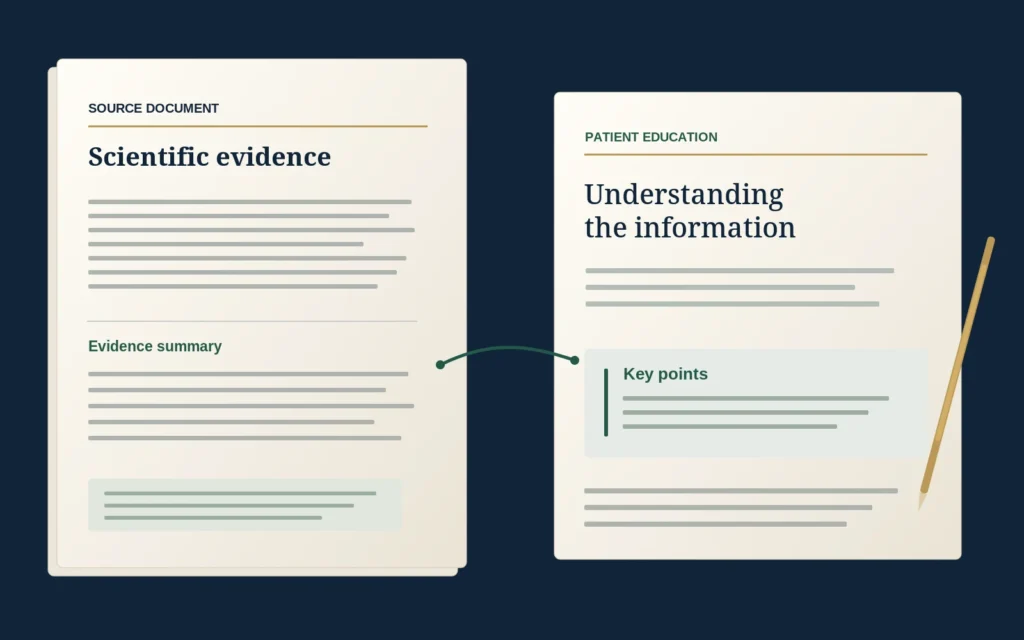
From Clinical Evidence to Clear Patient Education
Making clinical evidence easier to read is only the start. Explore how patient education can preserve qualifications, explain numbers, and serve a clear reader purpose.
Read article : From Clinical Evidence to Clear Patient Education