How to Request a Pharmacist Peer Reviewer for a Medical Journal
A useful peer-review invitation identifies the clinical question, expertise needed, and deadline. Here is what journal editors can send—and how authors can request a separate manuscript review.
Quick answer
To request a pharmacist peer reviewer, send the journal name, manuscript topic, article type, expertise needed, review instructions, and deadline. Confirm subject fit, conflicts, and an authorized sharing route before sending confidential material. Authors seeking a commissioned manuscript review should request a separate quote.
Looking for a medication-focused peer reviewer? Send a Peer-Review Invitation.
A pharmacist peer reviewer should fit the manuscript’s clinical question—not simply have a pharmacy qualification. For a journal editor, a useful invitation makes that question clear, identifies the expertise needed, and states the deadline.
Picture an editor opening a medication-focused submission. The writing is polished. The references look substantial. But the abstract makes a broader claim than the results appear to support. Who should assess that gap: a clinical pharmacist, a methods specialist, or both?
The answer starts with the work you need assessed. PharmacoLegal Consulting Services™ welcomes medication-related journal review inquiries. Send a peer-review invitation with the topic, journal, and deadline so PCS can assess fit.
What should a pharmacist peer reviewer assess?
Start with a focused question: which parts of this paper require medication expertise?
Depending on the assignment and the reviewer’s experience, those questions might concern the treatment description, dose and formulation, comparator, monitoring, adverse-event discussion, or clinical interpretation. A pharmacy practice paper may instead need someone familiar with the setting and service being studied.
Make the distinction explicit. “Review the medication-related interpretation” is a different assignment from “evaluate the statistical analysis.” COPE advises reviewers to represent their expertise accurately and identify gaps before accepting an assignment.[1]
A useful match allows the reviewer to contribute a clear clinical perspective while telling the editor where another specialist is needed.
What to include in the first invitation
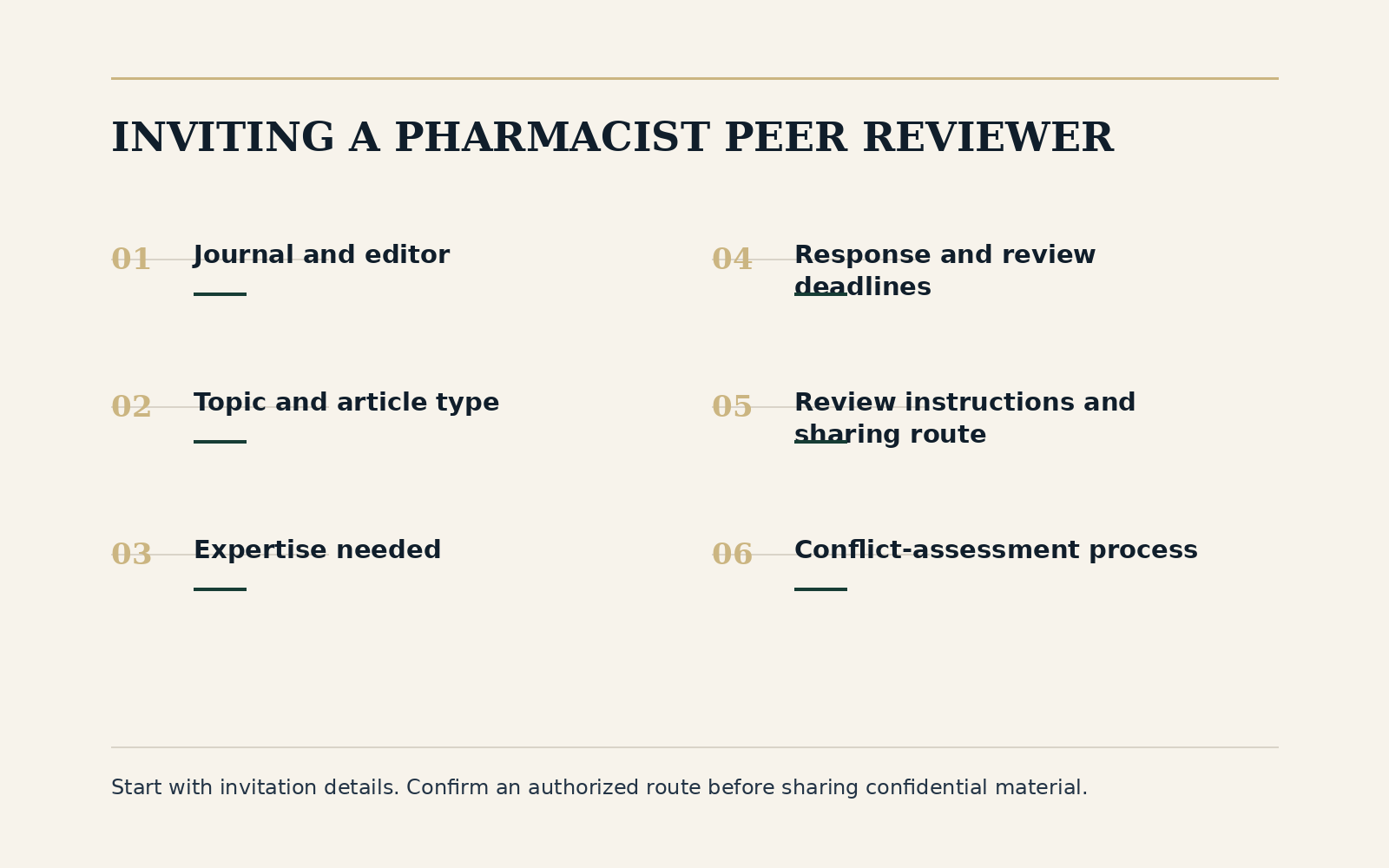
For a PCS inquiry, send enough information to assess fit without placing an unpublished manuscript into a general contact form. Start with the following:
- Journal and editor: the journal name, editorial contact, and official journal or publisher link.
- Topic and article type: the clinical question and whether the paper is original research, a review, a case report, or another format.
- Requested expertise: the medication, clinical interpretation, or pharmacy practice questions you want assessed.
- Timing: the response deadline and proposed review deadline.
- Review instructions: the journal’s reviewer guidance, review model, and submission route.
- Conflict assessment: how the journal provides the information needed to evaluate potential conflicts under its review model.
If an abstract can be shared under the journal’s policy, explain how it can be accessed securely. Otherwise, begin with a nonconfidential topic summary. PCS can then confirm the appropriate next step.
A clear invitation in practice
Original illustrative example. This is not a real journal invitation or a completed PCS assignment.
- Too broad
- “We have a pharmacy paper. Can you review it next week?”
- More useful
- “Our journal is assessing an observational study of a medication-related service in adult outpatient care. We need a reviewer to assess the treatment description and clinical interpretation. A separate reviewer will assess the statistical methods. Could you confirm your interest and availability for the proposed deadline? We can provide the abstract and conflict-assessment information through our editorial system.”
The second version makes a decision possible. It names the work, separates the expertise required, and identifies a route for the next exchange. Your own invitation should reflect the actual paper and your journal’s process.
What happens after you contact PCS?
The first step is a fit assessment: subject area, requested work, timing, and any relevant relationships. An inquiry is not an accepted assignment. Where the fit is appropriate, the next step is to confirm instructions and access through the journal’s process.
Journal editors select reviewers and retain responsibility for editorial decisions. A reviewer’s recommendation informs that decision; it does not determine acceptance.[2]
For PCS, the useful starting point is specific: “We need clinical assessment of these medication-related questions by this date.” That is easier to evaluate than an undefined request for a complete research audit.
What useful reviewer feedback looks like
A concern should lead to a question the author can answer or a revision the editor can evaluate. Consider this original, hypothetical comment:
- Location
- Abstract conclusion and final discussion paragraph.
- Concern
- The wording refers to all adults with the condition, but the described study population is narrower.
- Requested action
- Align the conclusion with the population studied and explain any proposed broader interpretation.
- Why it matters
- The abstract should not invite a broader reading than the reported evidence supports.
This example illustrates the structure of a comment, not a finding about a real study. For more on turning an observation into an actionable finding, see the review report guide. For assessing the evidence behind a sentence, see the reference-checking guide.
Keep confidentiality and independence part of the assignment
Review arrangements should establish confidentiality, relevant conflicts, and the journal’s rules before work begins. ICMJE addresses these responsibilities for editors and reviewers.[2] The invitation should also identify whether the review or reviewer identity may be published.
Tool use needs its own check. ICMJE’s AI guidance tells reviewers to follow the journal’s policy, seek permission where needed, protect confidential material, and disclose AI use.[3] A general-purpose upload box is not a substitute for the journal’s authorized manuscript system.
Are you an author seeking feedback before submission?
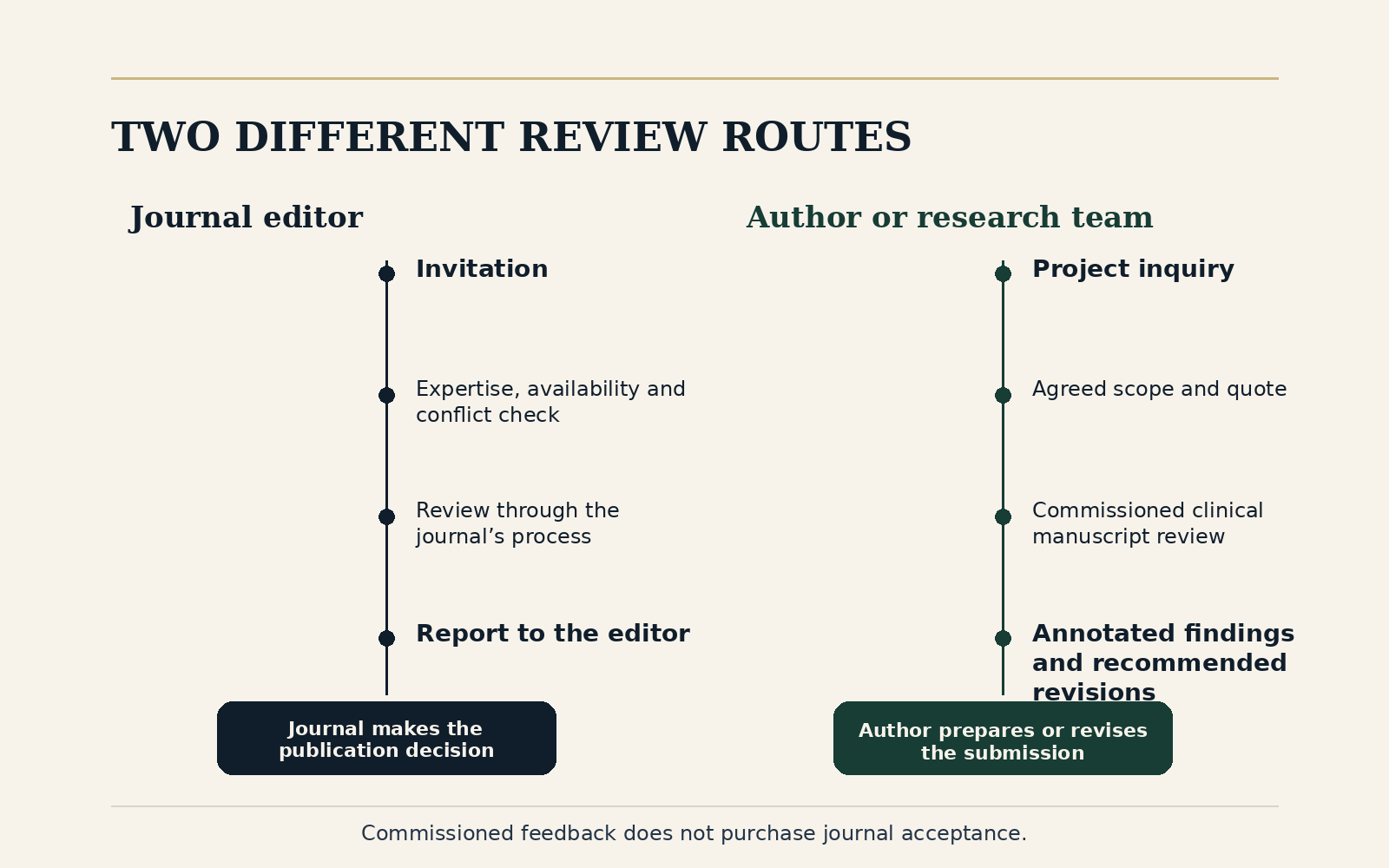
You have a different starting point. An author, publisher, or research team can commission a clinical manuscript review before submission or revision. PCS can quote for an annotated draft, prioritized findings, and recommended revisions within the agreed clinical scope.
Send the topic, approximate length, questions, and deadline to request a manuscript review quote. See Clinical Manuscript Review vs. Journal Peer Review for how commissioned review differs from a journal’s process. Authors remain responsible for their submission; commissioned feedback does not purchase journal acceptance.
Frequently asked questions
Can a journal editor invite PCS to review a medication-related manuscript?
Yes. Send a peer-review inquiry with the journal, topic, expertise needed, and deadline. Acceptance depends on relevant expertise, availability, conflicts, and the journal’s requirements.
Can authors request a paid manuscript review?
Yes. Use the manuscript review quote route for commissioned feedback. The journal arranges its own peer review. See Clinical Manuscript Review vs. Journal Peer Review for the distinction.
Does pharmacist peer review include statistical review?
Not automatically. Identify the methods and questions requiring assessment so the appropriate expertise can be confirmed. Clinical interpretation and specialist statistical evaluation may need different reviewers.
Should I upload the full unpublished paper with the first inquiry?
Begin with the topic and invitation details. Confirm an authorized sharing route before sending confidential material. Our confidentiality standard explains the publication’s approach.
References
- COPE Council. Ethical Guidelines for Peer Reviewers. Version 2, September 2017.
- International Committee of Medical Journal Editors. Responsibilities in the Submission and Peer-Review Process.
- International Committee of Medical Journal Editors. Use of AI by Reviewers.
Looking for a pharmacist peer reviewer?
Send the journal, topic, expertise needed, and review deadline. PCS will assess fit, availability, and conflicts.
Send a Peer-Review InvitationMore from the Review
Scroll or swipe to explore related articles. When the article list is focused, use the left and right arrow keys; Home and End jump to the beginning and end.
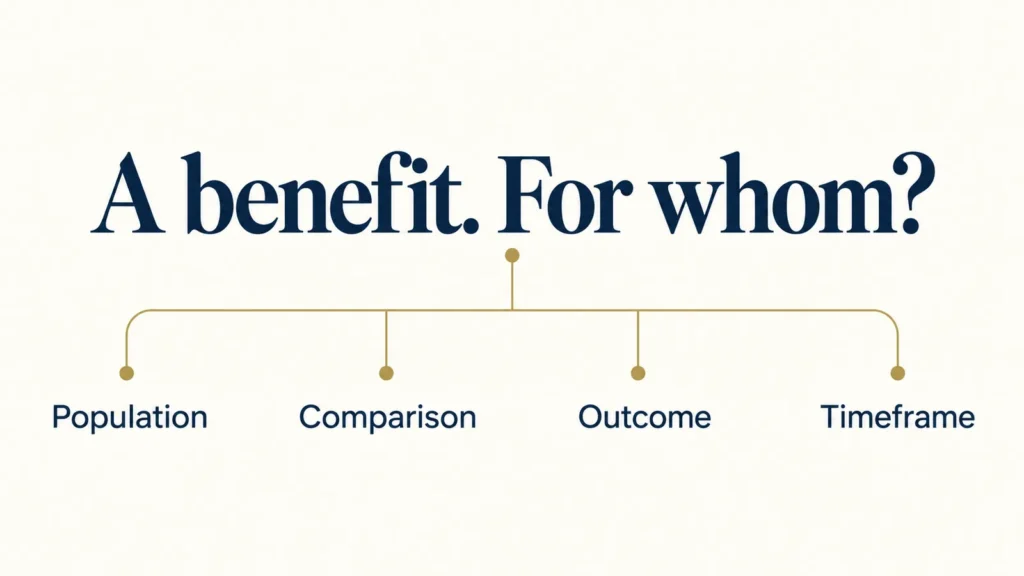
Reading a Medication Study: Population, Outcomes, and Limitations
A useful study summary keeps the population, comparison, outcomes, and limitations attached to the claim. Here is a practical reading sequence, with a published trial example.
Read article : Reading a Medication Study: Population, Outcomes, and Limitations
What a Useful Clinical Review Report Should Include
Clinical feedback is useful when the next decision is clear. Explore the scope, evidence, findings, proposed actions, and handoff a practical review report should contain.
Read article : What a Useful Clinical Review Report Should Include
Medical Literature Research: What a Targeted Review Can—and Cannot—Answer
A focused search can serve a useful purpose without being comprehensive. Understand what targeted literature research can answer, how to describe its limits, and when broader work is needed.
Read article : Medical Literature Research: What a Targeted Review Can—and Cannot—Answer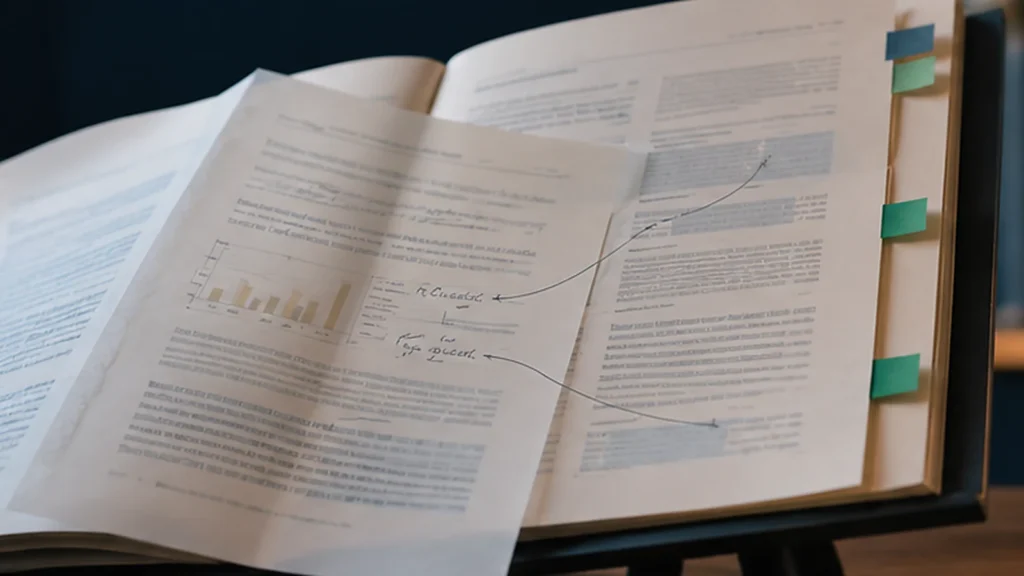
Clinical Manuscript Review vs. Journal Peer Review
A careful commissioned review can improve a manuscript without becoming journal peer review. Understand the roles, limits, and deliverables before choosing the service.
Read article : Clinical Manuscript Review vs. Journal Peer Review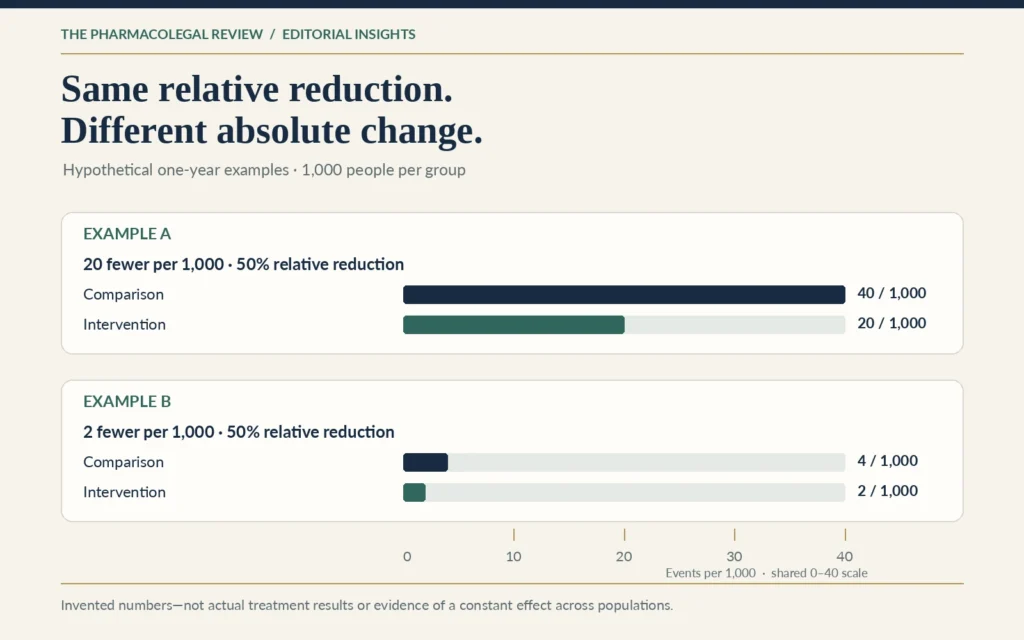
Understanding Absolute and Relative Risk in Medical Articles
A “50% reduction” needs a starting risk and a timeframe. Two clearly labeled hypothetical examples show how absolute and relative measures fit together—and where wording can mislead.
Read article : Understanding Absolute and Relative Risk in Medical Articles
Checking Medical References: Does the Source Support the Claim?
A citation can be relevant without supporting the sentence beside it. A practical guide to matching medical claims with evidence and leaving a useful editorial decision.
Read article : Checking Medical References: Does the Source Support the Claim?