Clinical Manuscript Review vs. Journal Peer Review
A careful commissioned review can improve a manuscript without becoming journal peer review. Understand the roles, limits, and deliverables before choosing the service.
Quick answer
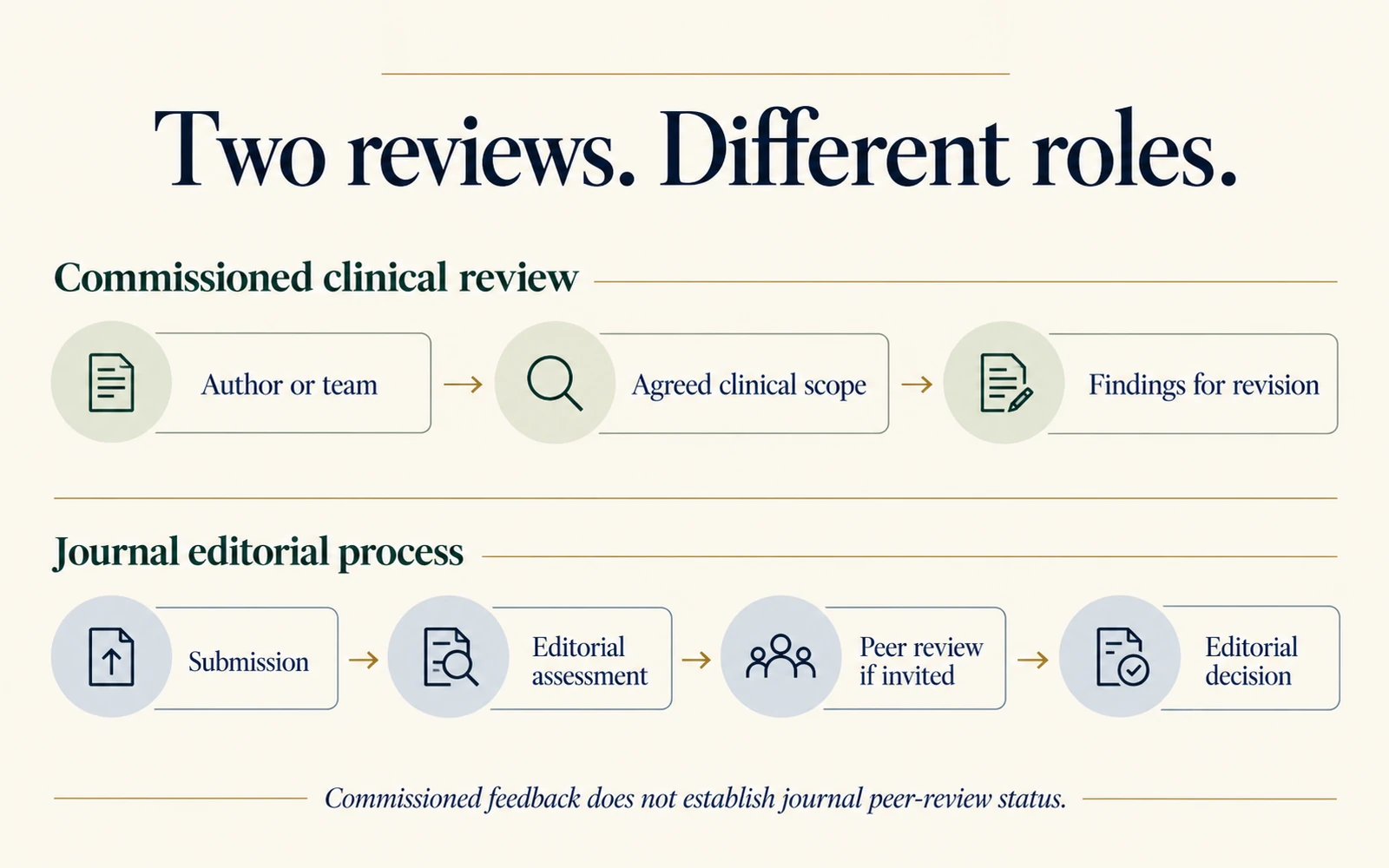
Clinical manuscript review is commissioned assessment of a draft within an agreed clinical scope. Journal peer review is arranged through a journal’s editorial process to inform its evaluation of a submission. Neither a consultant’s report nor favorable reviewer comments guarantee publication; describe each contribution accurately.
Have a draft that needs a clinical review? Request a Review Quote ↗
Clinical manuscript review can help an author or editorial team examine a draft before its next step. Journal peer review serves a different process: it helps a journal evaluate a submitted manuscript. The skills may overlap; the roles and authority do not.
Imagine a team receiving an annotated manuscript from a consultant. The methods need clarification, two claims need closer support, and the discussion now reflects the limitations more carefully. Someone asks, “Can we say it has been peer reviewed?”
That is where one useful service can acquire a label it has not earned.
This is an illustrative editorial scenario, not a client account. Here, clinical manuscript review means commissioned assessment of clinical content within an agreed scope. It does not imply statistical reanalysis, institutional approval, journal appointment, or an independent peer-review process.
Start with the question each review is answering
A commissioned review might ask whether the clinical terminology is accurate, whether the references support the conclusions, or whether the interpretation stays within the study’s findings. The assignment could be narrow or broad; its contract and deliverable should make that clear.
Journal peer review asks questions within a journal’s editorial process. ICMJE describes it as expert critical assessment of submitted manuscripts that assists editorial decisions and can improve reporting.[1]
Those purposes can intersect without becoming interchangeable. A consultant’s careful assessment may improve a submission while leaving the journal’s own assessment entirely ahead of it.
Before commissioning work, decide whether you need clinical feedback, editing, reference checking, methods expertise, or a combination. The guide to writing, editing, and clinical review separates these services.
Identify who commissioned the work and who decides
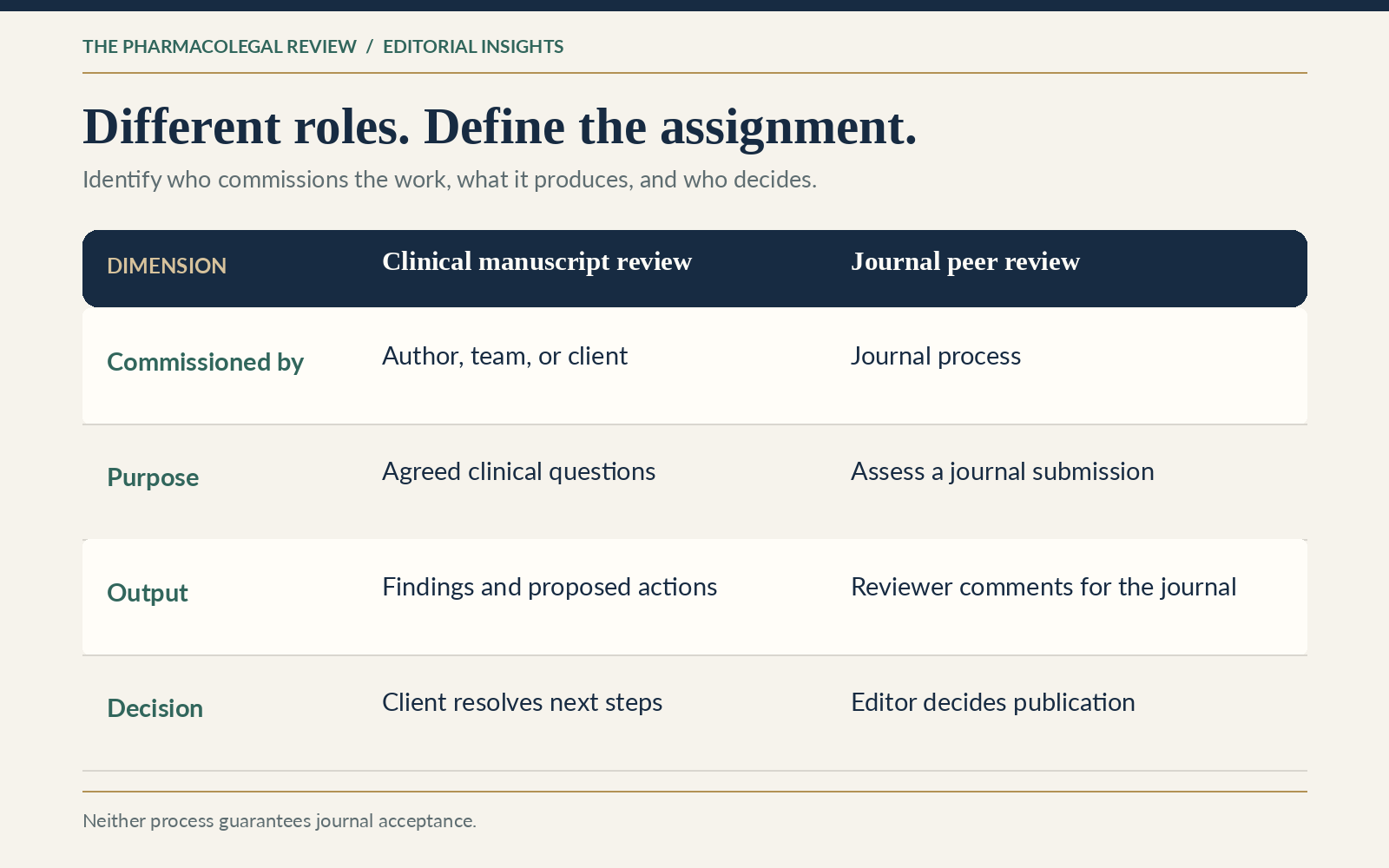
In a client project, the author, publisher, agency, or research team usually defines the assignment with the consultant. The review can produce proposed changes and unresolved questions; publication authority is not automatically transferred to the reviewer.
For journal peer review, the journal arranges its process. ICMJE places responsibility for content selection with the editor; favorable reviewer comments do not require a journal to publish a manuscript.[1]
That distinction matters when describing the deliverable. “Clinical comments supplied on version three” is concrete. “Publication approved” may suggest an authority the consultant was never given.
A useful project brief identifies who will assess proposed changes, whether a revision check is included, and what the author must do before submission.
Define what clinical manuscript review actually includes
The label is not a substitute for a scope. A medication-focused clinical review may examine the terminology, clinical context, consistency of reported details, and relationship between claims and sources. It need not include a full assessment of every research method.
Likewise, a literature-based discussion may need different expertise from an original study with complex statistical analyses. Identify when the question requires a statistician, information specialist, subject specialist, or another reviewer.
Do not imply that a second set of eyes reproduced the study or verified underlying data unless that work was actually performed.
The clinical review report guide describes a handoff that records findings, evidence, proposed actions, and open questions. The point is to make the work inspectable, not to make its name sound more impressive.
Check the reporting requirements without treating a checklist as validation
A journal’s author instructions can affect the manuscript’s structure, disclosures, references, and supporting material. ICMJE also directs authors toward reporting guidelines appropriate to their study design.[2]
A reporting checklist can help reveal missing information. Completing it does not establish that the study was well designed or that all conclusions are justified.
For example, a reviewer may notice that the manuscript does not clearly identify an outcome or explain a limitation. The next step is to clarify what happened and whether the wording is supported—not to invent a method that would make the report look complete.
A consultant can flag a gap. The responsible authors need to resolve questions about their own study and reporting.
Describe contributions and relationships accurately
A paid review can be valuable while still being a commissioned service. Describe it according to what was done. Avoid turning a client relationship into a claim of independent journal endorsement.
Authorship and acknowledgment also need attention. Under ICMJE’s recommendations, writing assistance or editing alone does not satisfy authorship requirements; non-author contributions should be acknowledged appropriately, with permission.[3] Apply the target journal’s policies and the actual contribution rather than assuming that a fee or a title determines the byline.
Keep the record specific: who contributed, what they did, what material they assessed, and how relevant relationships are disclosed.
Agree on handling before sharing unpublished work
For a commissioned project, agree on the permitted recipients, tools, storage, and handling of confidential materials before transferring a manuscript. Do not assume an external service can receive every document simply because the author wants an additional opinion.
Journal reviewers have responsibilities to the journal’s process, including confidentiality. ICMJE’s guidance also addresses permission for assistance and AI use in peer review.[1] If someone is reviewing on a journal’s behalf, they should follow that journal’s instructions rather than treat the invitation as permission to outsource the review.
For client work, the practical question is straightforward: does the agreed process protect the material and match the permissions available?
Ask for the result your project needs
Commission a deliverable rather than an impressive label. Request an annotated draft, a referenced findings memo, claim-to-source checks, or a defined revision review. State which parts of the manuscript and supplementary materials are included.
Provide the intended audience, target publication if known, current version, source files, and deadline. If the team already has journal comments, clarify whether the assignment includes helping draft a response. Any proposed response must reflect revisions and evidence the authors can substantiate.
See what to include in a medical writing brief before preparing an inquiry. PCS clinical content review can be scoped around relevant clinical and medication-content questions, with additional specialist needs identified at the outset.
The useful promise is a defined piece of work and a clear handoff. Journal acceptance is a separate decision.
Frequently asked questions
Does clinical manuscript review make a paper peer reviewed?
A commissioned clinical review does not establish that the paper completed a journal’s peer-review process. Describe the work performed and avoid implying journal endorsement or independent certification.
Can a consultant help with journal reviewer comments?
Support can be scoped around clinical interpretation, source checks, proposed revisions, or response wording. Authors remain responsible for the accuracy of their responses. Specify the requested output in the project brief.
Is statistical review included automatically?
No. Statistical analysis, data verification, and clinical content review require distinct scopes and appropriate expertise. Ask what will be checked and what needs another specialist. The review report guide explains how to record those boundaries.
What should I request before submission?
Identify the manuscript stage, clinical questions, source access, target journal requirements, and desired deliverable. Explore PCS project services to prepare a focused inquiry; no service can guarantee journal acceptance.
References
- International Committee of Medical Journal Editors. Responsibilities in the Submission and Peer-Review Process.
- International Committee of Medical Journal Editors. Preparing a Manuscript for Submission to a Medical Journal.
- International Committee of Medical Journal Editors. Defining the Role of Authors and Contributors.
Have a draft that needs a clinical review?
Get annotated feedback on medication accuracy, source support, and clinical context. Send your topic, deliverable, and deadline to start a proposal.
More from the Review
Scroll or swipe to explore related articles. When the article list is focused, use the left and right arrow keys; Home and End jump to the beginning and end.

What a Useful Clinical Review Report Should Include
Clinical feedback is useful when the next decision is clear. Explore the scope, evidence, findings, proposed actions, and handoff a practical review report should contain.
Read article : What a Useful Clinical Review Report Should Include
Medical Literature Research: What a Targeted Review Can—and Cannot—Answer
A focused search can serve a useful purpose without being comprehensive. Understand what targeted literature research can answer, how to describe its limits, and when broader work is needed.
Read article : Medical Literature Research: What a Targeted Review Can—and Cannot—Answer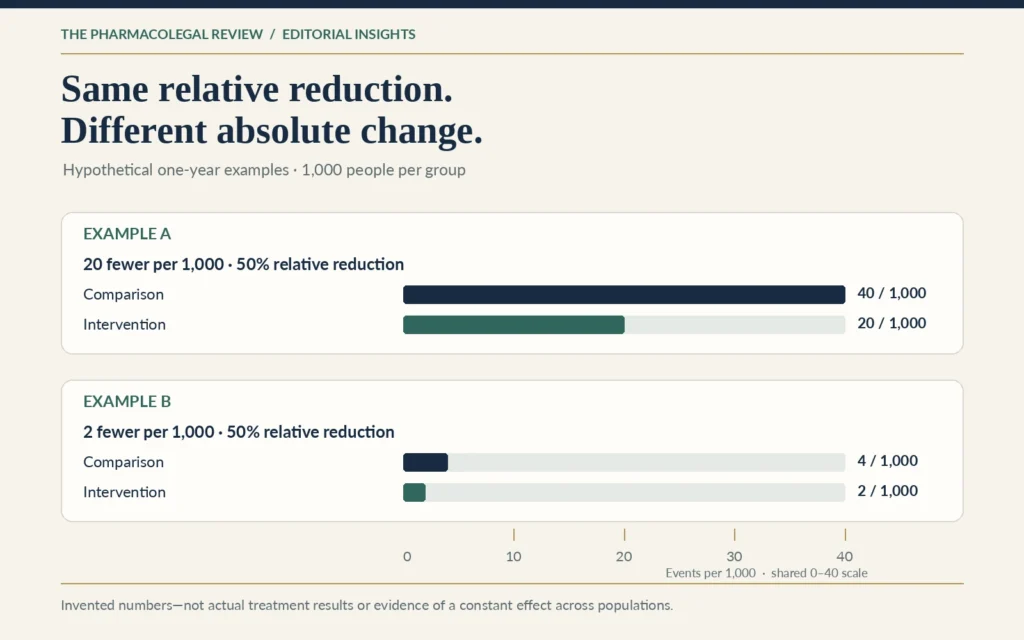
Understanding Absolute and Relative Risk in Medical Articles
A “50% reduction” needs a starting risk and a timeframe. Two clearly labeled hypothetical examples show how absolute and relative measures fit together—and where wording can mislead.
Read article : Understanding Absolute and Relative Risk in Medical Articles
Checking Medical References: Does the Source Support the Claim?
A citation can be relevant without supporting the sentence beside it. A practical guide to matching medical claims with evidence and leaving a useful editorial decision.
Read article : Checking Medical References: Does the Source Support the Claim?
Common Accuracy Problems in Medication Content
A polished medication article can still imply more than its evidence supports. Six practical review targets reveal where meaning can shift—and how to document a useful correction.
Read article : Common Accuracy Problems in Medication Content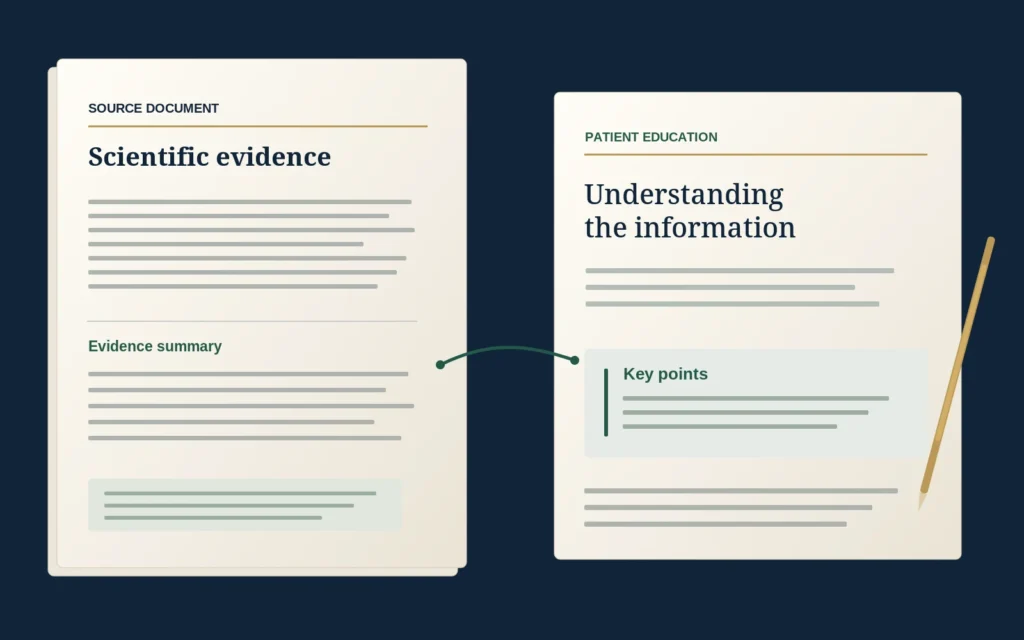
From Clinical Evidence to Clear Patient Education
Making clinical evidence easier to read is only the start. Explore how patient education can preserve qualifications, explain numbers, and serve a clear reader purpose.
Read article : From Clinical Evidence to Clear Patient Education