An order, a claim, and a clinical note do not establish the same thing. Learn how a focused review separates documented findings from unresolved questions.
Quick answer
Medication records can document prescribing instructions, dispensing activity, recorded administration, and clinical observations. The supported finding depends on the source and its completeness. A record alone may not establish actual use, the reason for a change, or causation. A focused review links findings to sources and identifies follow-up questions.
Medication records can document prescribing instructions, dispensing activity, recorded administration, and clinical observations. What medication records can establish depends on the source, the question, and the completeness of the material supplied. A useful review makes those connections visible.
Imagine a file containing a medication order, a pharmacy claim, and a note that says the patient stopped treatment. All three may be accurate. None is a substitute for the others. The order describes an instruction; the claim records a transaction; the note documents information recorded at that encounter.
PharmacoLegal Consulting Services™ examines medication-related records around a defined question. Clients can commission source-linked findings, a medication chronology, and questions for follow-up. Request a Records Review Quote with the question, approximate record volume, and deadline.
Start with the source, then the statement
A record is most useful when you can say precisely what it shows. Before summarizing an entry, identify its document type, date, source location, and relationship to the question being examined.
For example, “the discharge list includes Medication X” describes the document. “The patient took Medication X after discharge” adds a different proposition. Establishing the second may require other information.
This distinction is not an argument for doing less with the records. It is how the review produces findings that another person can check. See the medical record review guide for attorneys for the wider assignment.
What different medication records can show
Prescribing orders
Documented instructions and recorded changes, including medication, dose, route, timing, and discontinuation where those details appear. An order alone does not document that a dose was administered.
Dispensing records and claims
Recorded supply or transaction information, interpreted in light of the source and any reversals or corrections. A transaction does not establish that the patient took every dose.
Medication administration records
Recorded administration, holds, refusals, or other statuses, with available times and details. The actual entry, amendments, and completeness of the supplied record matter.
Medication histories and clinical notes
Information documented at an encounter, including reported use, symptoms, and the clinician’s recorded reasoning. Distinguish a report, an observation, and an assessment rather than merging them.
Discharge and transition documents
Recorded instructions or lists at a change in setting. Compare these with relevant orders and notes when the question concerns a treatment change.
Source labels do not settle the whole clinical question. They help the reviewer make the right comparison. AHRQ’s medication reconciliation guidance describes comparing medication information and clarifying discrepancies during care transitions.[1] A retrospective consulting review can examine related documentation, but it is a separately defined assignment.
A supported finding versus an attractive shortcut
Original invented example. Medication X is a placeholder; no actual patient or client matter is represented.
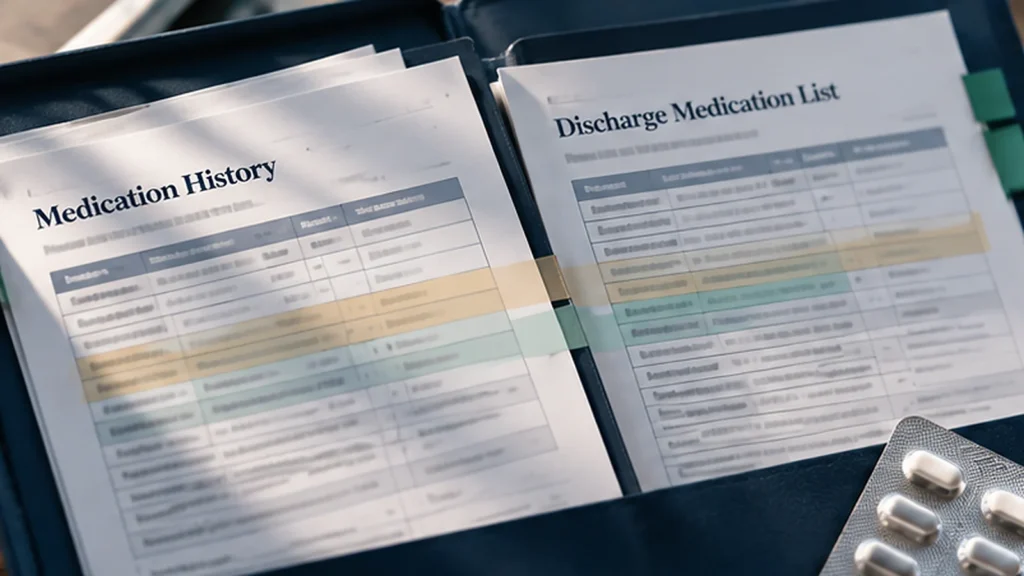
An outpatient order lists Medication X. A later discharge list does not include it. The supplied pages do not contain an explanation for the difference.
Supported statement
Medication X appears in the supplied outpatient order and is absent from the supplied discharge list. No explanation for that difference was located in the reviewed pages.
Unresolved question
Was the medication intentionally stopped, omitted from the list, replaced, or addressed in material not yet supplied?
Useful next step
Identify the relevant inpatient orders, progress notes, reconciliation documentation, or clarification needed to examine the change.
The shortcut is to label the omission a prescribing error immediately. The useful work is to locate the difference, test possible explanations against the evidence, and show what remains unresolved. An unexplained difference deserves attention; it is not already its own explanation.
Separate the finding from the interpretation
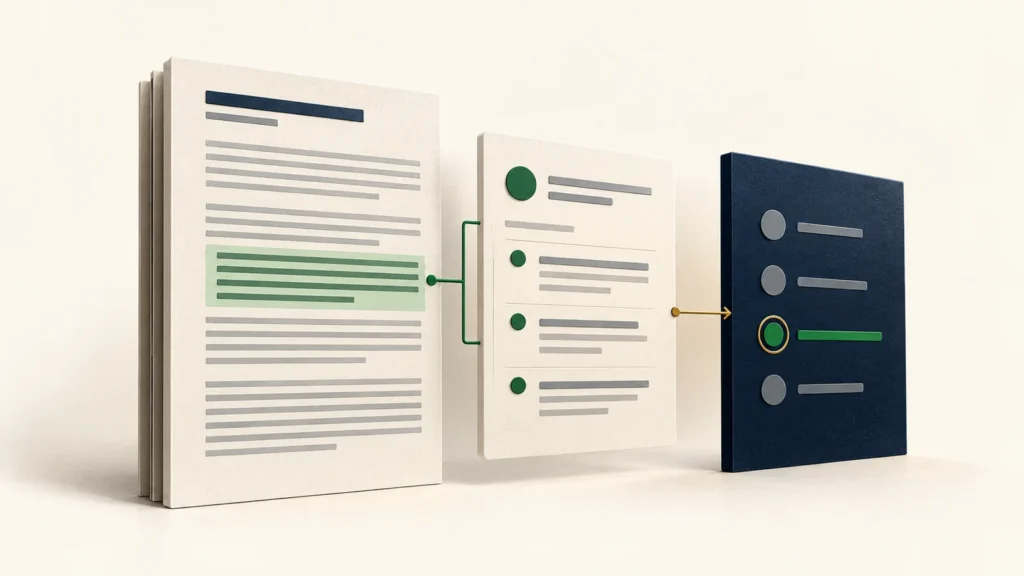
A practical report can keep three elements distinct: the source entry, the reviewer’s analysis, and the next question. That structure gives a team something it can act on without making the source say more than it does.
Interpretation is part of professional analysis. It should identify the reasoning and supporting material that connect it to the records. If a conclusion depends on an assumption—such as whether the supplied administration record covers the full interval—state that assumption beside the finding.
A gap note should name the missing interval or document, explain which question it affects, and identify the next source to seek. “No administration entry located in the supplied pages for this period” is more informative than a blanket statement that the records are incomplete.
When sources conflict, retain both entries and their references. Check whether they concern the same date, setting, medication formulation, or event. A home history and an inpatient order can differ because care changed; a duplicated note can look like a second observation when it is not.
If the difference remains unresolved, say what each source supports. A clear unresolved finding can be more useful than a tidy account that hides the uncertainty.
What about a medication followed by an adverse event?
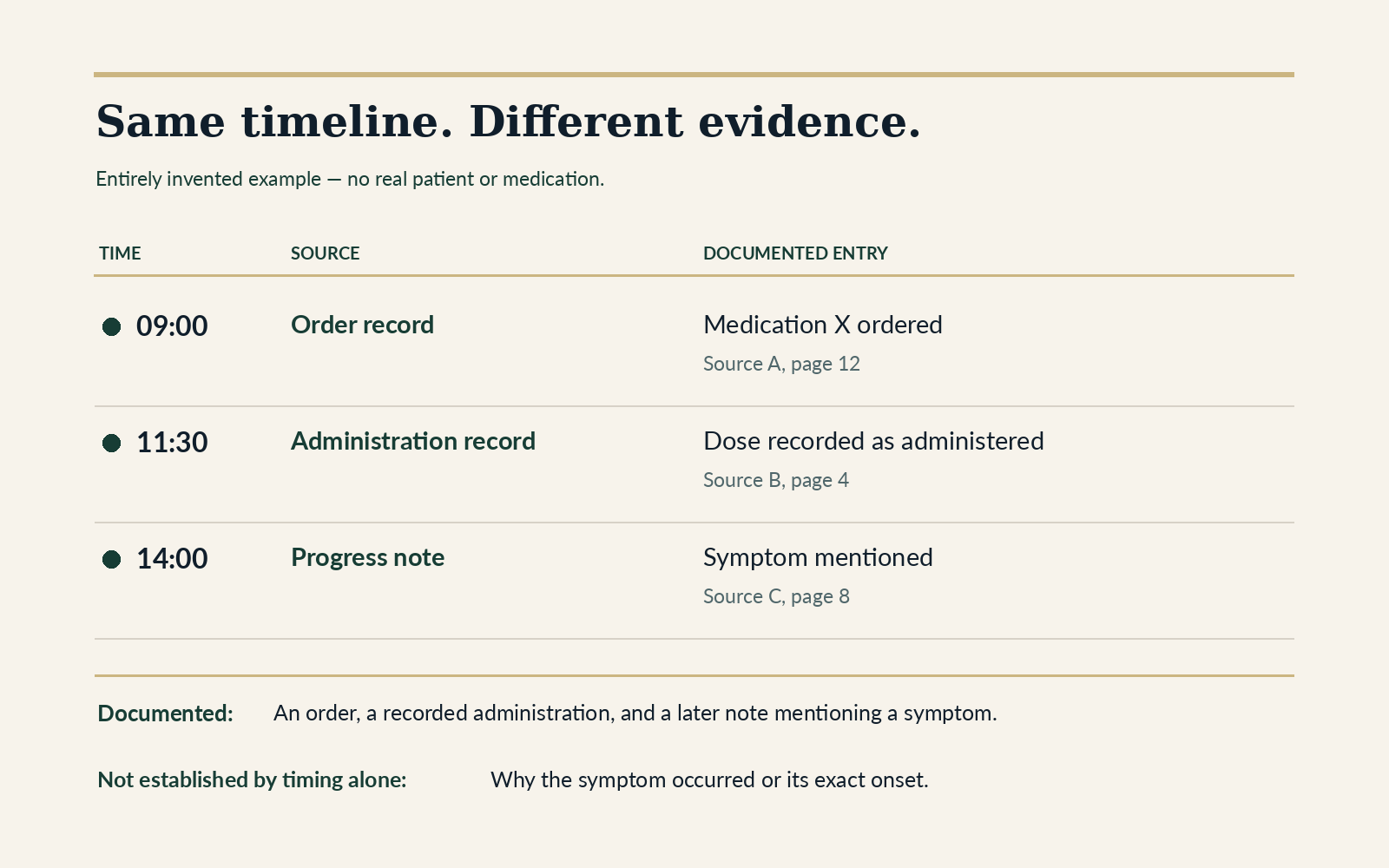
Sequence helps frame the question. It does not answer it alone. A case-specific assessment may need the treatment history, timing, clinical findings, competing explanations, and relevant external evidence.
FDA similarly cautions that an adverse-event report in its reporting system does not establish that a product caused the event.[2] That limitation concerns reporting data; it should not be treated as a method for resolving an individual case.
If your question concerns causation, identify it at the outset so the appropriate analysis and expertise can be considered. Do not ask a chronology to carry a conclusion it was not commissioned to assess.
How to commission the review
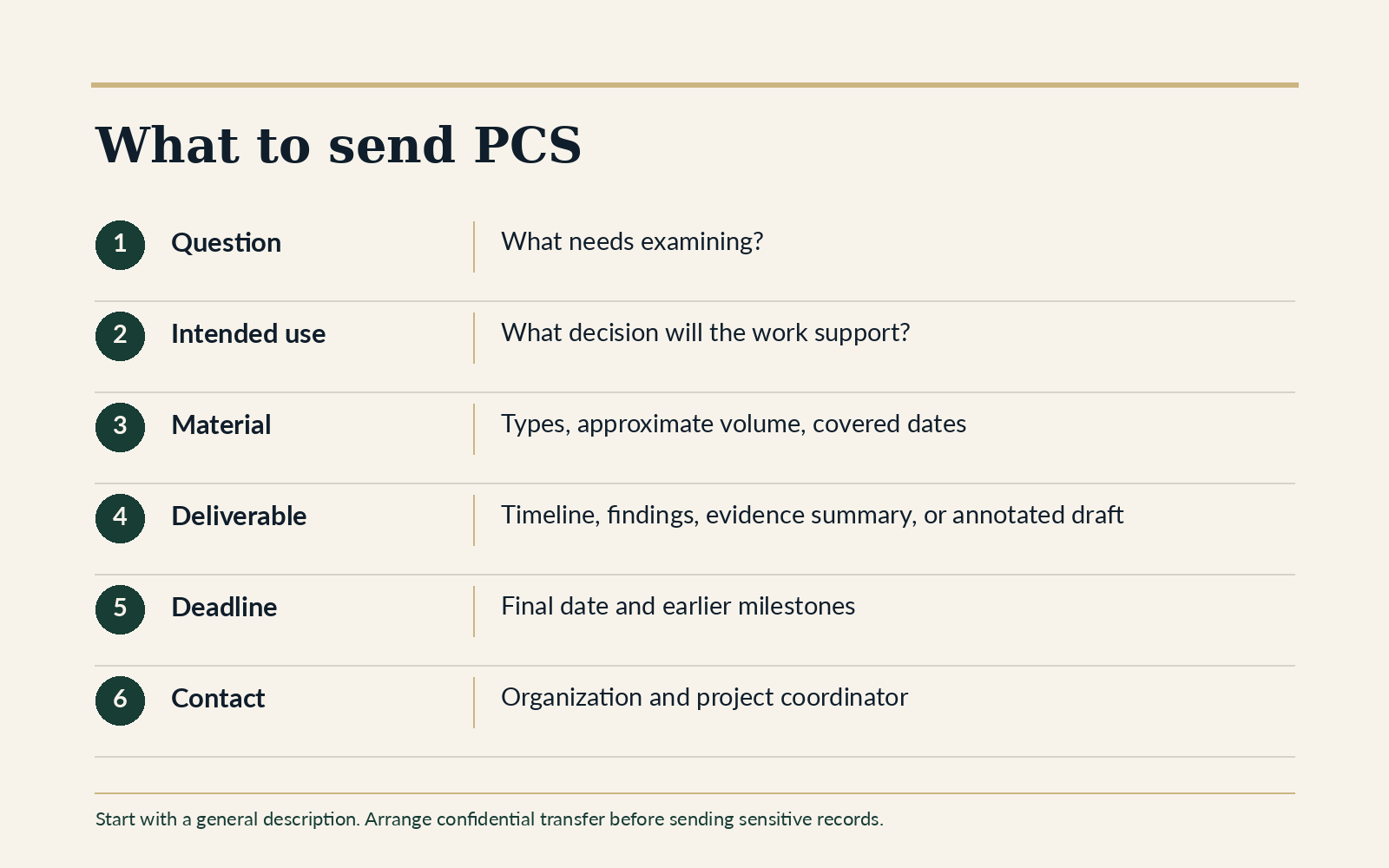
Send PCS a general description of the question, available documents, date range, approximate volume, intended output, and deadline. The consulting inquiry guide makes this first message straightforward.
PCS clarifies the assignment and provides a proposal with deliverables, fee, timing, and payment arrangements. Relevant conflict checks and confidential sharing arrangements come before substantive work. Testimony, if being considered, is a separate role to discuss.
An order documents prescribing instructions. Establishing use requires consideration of the relevant records and other information. See the record-type guide for the distinctions.
Does a missing administration entry prove a dose was missed?
Not by itself. Identify the material reviewed, the interval, and whether additional records or clarification are needed. The medication timeline guide shows how to describe gaps precisely.
Can PCS identify questions for further investigation?
A defined review can include documented discrepancies, missing information, and follow-up questions. Request a review quote describing your clinical question and intended deliverable.
Can a literature review be added to the records work?
Yes, a focused evidence task can be proposed alongside the records analysis. Read the targeted literature research guide and include that question in your inquiry.
Scroll or swipe to explore related articles. When the article list is focused, use the left and right arrow keys; Home and End jump to the beginning and end.
Medication entries tell different parts of a clinical story. See how a focused records review can organize the documented events, discrepancies, and questions your legal team needs to examine.
A patient resource needs more than accurate sentences. See how to commission clear, referenced materials built around your audience and their next step.
A useful peer-review invitation identifies the clinical question, expertise needed, and deadline. Here is what journal editors can send—and how authors can request a separate manuscript review.
An older medical article may need a targeted correction, a full rewrite, or a different place in the site. Use a practical review process to decide what changes and who handles the update.