Common Accuracy Problems in Medication Content
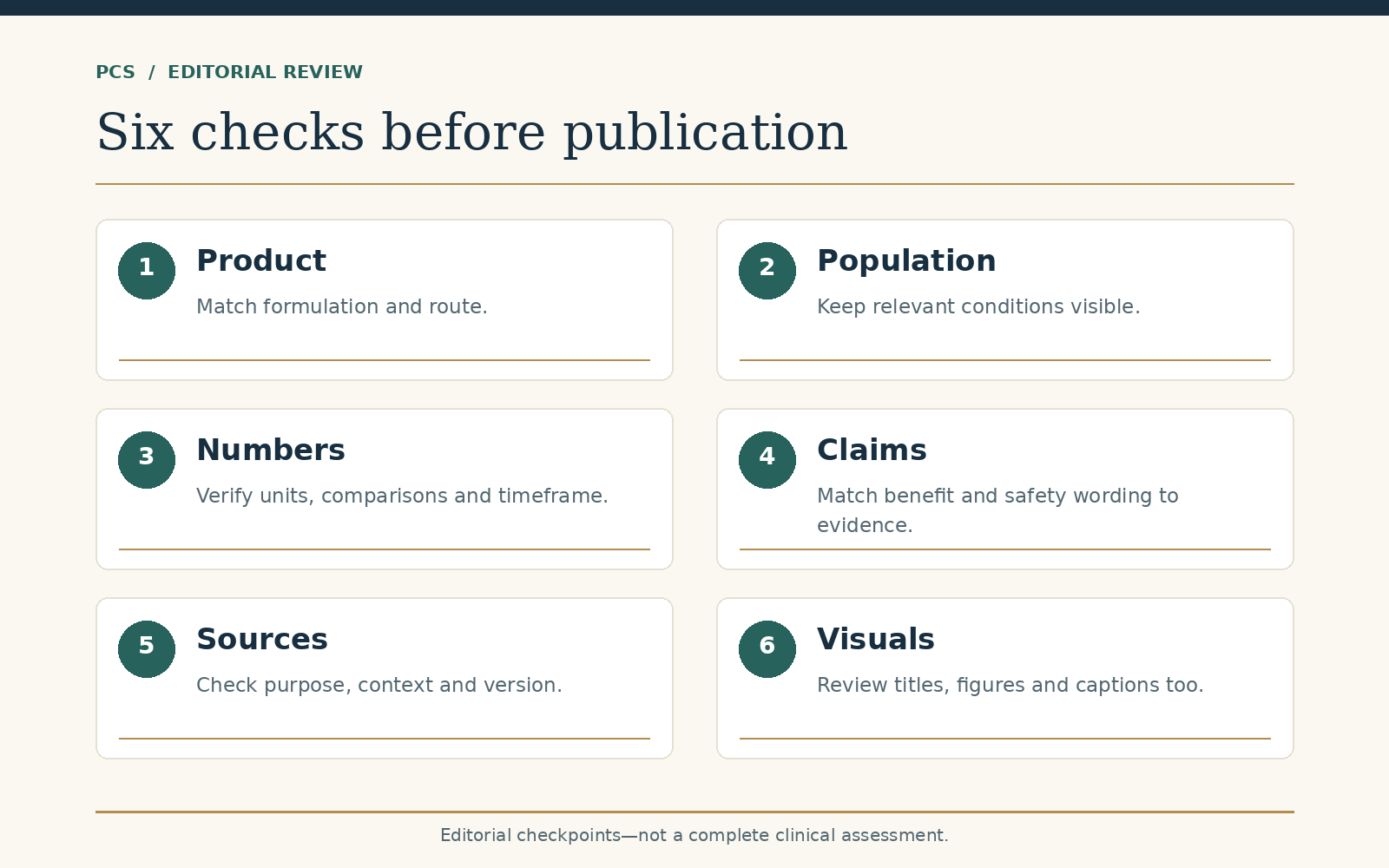
A polished medication article can still imply more than its evidence supports. Six practical review targets reveal where meaning can shift—and how to document a useful correction.

Quick answer
Medication content accuracy review checks the product and formulation, population, numbers and units, benefit and safety wording, source version, and consistency across text and visuals. Record the concern, supporting evidence, proposed correction, and unresolved questions within an agreed scope.
Medication content accuracy problems can hide inside a sentence that sounds entirely reasonable. The grammar works. The reference looks respectable. The missing detail is the one that changes what the reader takes away.
Imagine a draft that says a medicine “works within hours.” An editor asks a small question: works in what sense? A measurable change, a symptom the patient notices, or the outcome the article is discussing?
That question can send the team back to the source. The sentence may need a qualification, a different reference, or removal. A more elegant verb will not settle it.
This is an illustrative editorial scenario, not a patient or client account. The problems below are practical review targets, not a ranked list of the most frequent errors in published content.
1. Treating the medicine’s name as the whole description
A generic name can be a starting point without being a complete description of the product under discussion. Formulation, route, strength, and release characteristics may matter to the statement.
For a product-specific claim, establish which product the source describes before carrying its instructions into an article. A statement about one presentation should not become a statement about every presentation with a similar name.
FDA’s guide to prescription labeling identifies separate sections for dosage and administration, dosage forms and strengths, and use in specific populations.[1] Those distinctions are useful places to begin a product-level check.
A practical margin note might read: “Confirm the exact formulation and route; this reference appears to describe a different presentation.” That gives the writer a question to resolve rather than a vague request to “check accuracy.”
2. Dropping the population or conditions
“Studied in adults with a defined condition” and “suitable for people with that condition” are different claims. So are an approved indication, an investigational use, and a discussion of practice beyond the approved labeling.
A useful review asks which population the source addresses and whether a restriction disappeared during editing. It also distinguishes what a source reports from what the article recommends.
The correction does not always require a long disclaimer. Sometimes a short qualifying phrase restores the essential boundary. Sometimes the claim itself needs to change.
For the broader review process, see what a pharmacist reviews in medical content.
3. Leaving numbers and units open to interpretation
A medication number needs its meaning attached. Is it a strength, a concentration, an amount per administration, or a quantity over a stated period? Has the denominator survived the edit? Does the figure use the same units as the source?
These are questions to verify against the relevant material, not invitations to calculate or supply missing prescribing instructions from memory.
ISMP identifies abbreviations, symbols, and dose designations associated with harmful or potentially harmful misinterpretation.[2] Its list is a useful reference when examining medication notation; a familiar abbreviation is not automatically an appropriate one.
For numbers describing outcomes, the reader also needs enough context to understand the comparison and timeframe. CDC’s Clear Communication Index explicitly emphasizes explaining numbers in context.[3]
A percentage without a clear explanation can look precise while doing very little useful work.
4. Expanding a benefit or shrinking a safety statement
Look for the small words that carry a large claim: “prevents,” “safe,” “always,” “only,” or “no interactions.” Ask what evidence would be needed to support that exact wording.
An observed association should not quietly become proof of causation. A change in a measured endpoint should not become an unqualified promise about a different health outcome. An absence of information in the selected source is not the same thing as evidence that a risk does not exist.
Safety language deserves the same scrutiny as benefit language. FDA’s labeling guide distinguishes contraindications, warnings and precautions, adverse reactions, and interactions.[1] They should not be flattened into one casual statement that a medicine is either “safe” or “unsafe.”
The editorial job is to preserve the relevant distinction at the level of detail the audience needs.
5. Using a reference without checking its version or purpose
An old reference is not wrong merely because it is old. But a statement about current labeling, an approval, or a current safety recommendation needs a check appropriate to that claim.
Record the product, source version or date, and the location supporting the statement. FDA notes that the Highlights of Prescribing Information are a summary and should not be used alone.[1] Reading a relevant section in context matters more than collecting an impressive-looking link.
Likewise, an educational overview may be useful for explaining a concept without being the right source for a detailed product instruction. Choose evidence for the job the sentence is doing.
6. Reviewing the paragraph while the graphic tells a different story
A careful body paragraph cannot rescue a headline that overpromises or a diagram that leaves out the qualification. Readers may encounter the graphic first—and may never read the paragraph that explains its limits.
Compare the article’s title, summary, captions, labels, tables, and highlighted boxes with the same evidence used to check the body. Check that “may” has not become “will” in the artwork and that a group result has not been illustrated as a personal guarantee.
For patient-facing material, also ask what someone unfamiliar with the subject is likely to infer. Translating clinical evidence into patient education requires attention to meaning across the whole reading experience.
What a useful accuracy review should leave behind
A long trail of “please check” comments is not much of a handoff. A useful review makes its reasoning visible enough for the team to act.
- Locate the concern: identify the sentence, caption, or figure.
- Explain the mismatch: say what the text implies and what the source supports.
- Point to the evidence: include the relevant section, table, or passage.
- Propose the next step: revise, qualify, replace the reference, or obtain further review.
- Record what remains open: distinguish a resolved edit from a question awaiting evidence or a decision.
Agree on the scope before review starts: supplied-source checking, a broader evidence search, editing, and final proof review are different amounts of work. The guide to writing, editing, and clinical review explains those distinctions.
The objective is not to make every sentence longer. It is to make each important sentence mean what the evidence permits it to mean.
Frequently asked questions
Is medication content accuracy the same as good copyediting?
No. Copyediting can improve consistency and readability without establishing that a medication claim is supported. A project may need both editorial and clinical work. See which kind of review your project needs.
Does every medication article need dosing information?
No. Include it only when it serves the defined purpose and can be presented with appropriate context and review. Adding unnecessary dosing detail creates another set of statements that must be verified. Audience and scope belong in the medical writing brief.
Can a pharmacist review existing articles rather than rewrite them?
A review can be scoped around an existing draft, its references, and specific clinical questions. Agree whether the deliverable is annotated copy, a findings summary, proposed wording, or a combination. Explore clinical content review services when preparing the inquiry.
Does a clinical review guarantee the article has no errors?
No. A defined review adds scrutiny within an agreed scope; it is not a guarantee or an individualized treatment recommendation. Final publication responsibilities, unresolved questions, and any further approvals should be clear to the team.
References
- U.S. Food and Drug Administration. How Do I Use Prescription Drug Labeling.
- Institute for Safe Medication Practices. List of Error-Prone Abbreviations.
- Centers for Disease Control and Prevention. Does the Material Always Explain What the Numbers Mean?
Publishing medical or medication content?
Request an annotated clinical review of accuracy, evidence support, and audience clarity.
More from the Review
Scroll or swipe to explore related articles. When the article list is focused, use the left and right arrow keys; Home and End jump to the beginning and end.
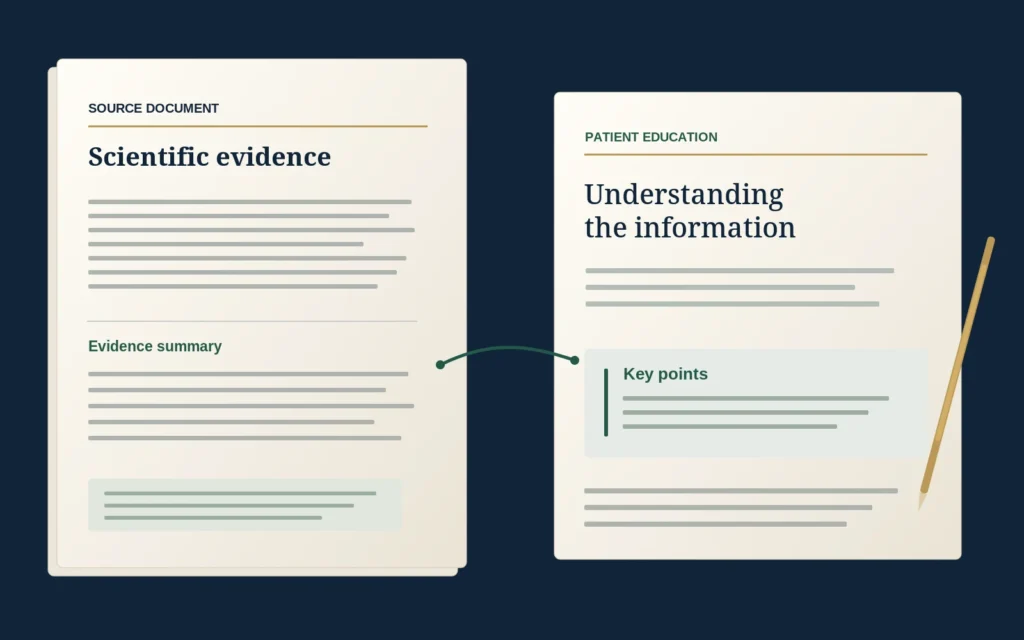
From Clinical Evidence to Clear Patient Education
Making clinical evidence easier to read is only the start. Explore how patient education can preserve qualifications, explain numbers, and serve a clear reader purpose.
Read article : From Clinical Evidence to Clear Patient Education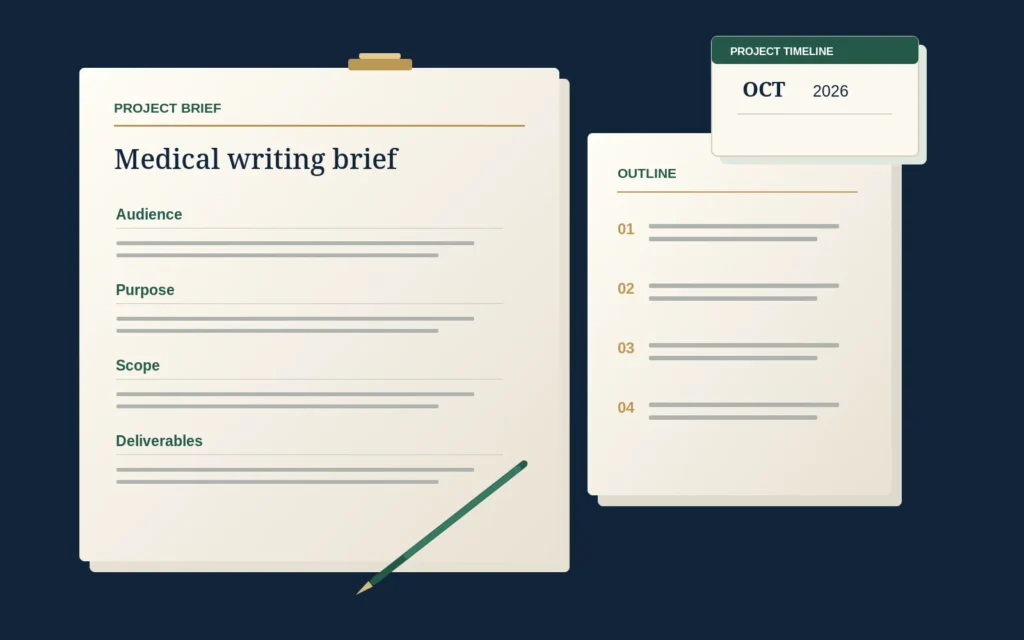
What to Include in a Medical Writing Brief
A topic, word count, and deadline are the beginning of a conversation. Use this practical guide to define the writing assignment before assumptions become revisions.
Read article : What to Include in a Medical Writing Brief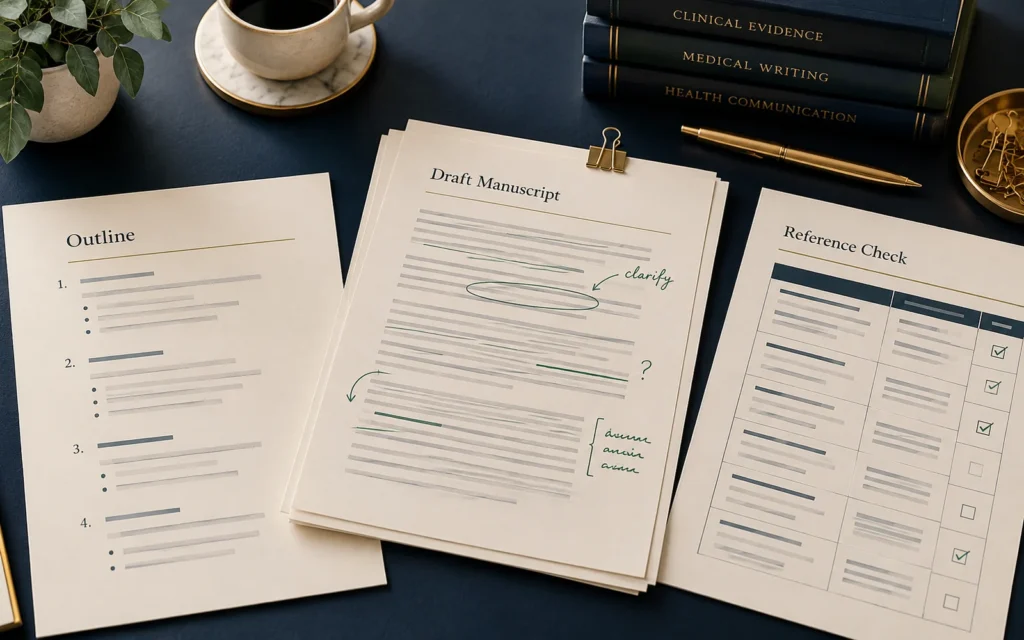
Medical Writing, Editing, and Clinical Review: Which Does Your Project Need?
“Please polish” can conceal three different assignments. Learn how writing, editing, and clinical review differ—and how to commission the work your document actually needs.
Read article : Medical Writing, Editing, and Clinical Review: Which Does Your Project Need?
Writing Medical Articles for Physicians and Patients: What Changes?
The same evidence can serve different readers without becoming the same article. Explore how audience changes structure, terminology, and clinical explanation.
Read article : Writing Medical Articles for Physicians and Patients: What Changes?
What Does a Pharmacist Review in Medical Content?
A polished sentence can still need a clinical correction. Explore what a pharmacist reviews in medical content, how useful feedback looks, and what a client should receive.
Read article : What Does a Pharmacist Review in Medical Content?
What a Useful Clinical Review Report Should Include
Clinical feedback is useful when the next decision is clear. Explore the scope, evidence, findings, proposed actions, and handoff a practical review report should contain.
Read article : What a Useful Clinical Review Report Should Include