Medication Timelines: Separating Documented Events from Interpretation
An order, a recorded dose, and a later symptom note tell different parts of a story. A useful medication chronology keeps those distinctions visible.
Quick answer
A medication timeline arranges documented medication events in sequence with source references. It distinguishes orders, dispensing, recorded administration, and reported information; preserves conflicting entries and missing information; and separates documented facts from interpretation. It does not establish causation from timing alone.
Have a medication-related project? Discuss a Consulting Project.
A medication timeline organizes documented medication events in date order and connects each entry to its source. Its value is not just showing what happened first. It is showing what the supplied records actually support—and where the story is still incomplete.
An order says a treatment should start. A later note mentions that treatment. An administration entry records a dose. Put all three into a single row marked “medication given,” and the chronology has become more certain than its sources.
PharmacoLegal Consulting Services™ prepares medication-focused records analysis around a defined question. A commissioned timeline can include source references, identified differences, and questions for follow-up. Request a Medication Timeline Quote with the covered period, record volume, and deadline.
What should a medication timeline help you see?
Start with the question. Are you tracing a dose change, comparing instructions at discharge, or examining the sequence around a documented clinical event? A timeline built for one question may need different entries from a general treatment history.
The finished chronology should let a reader move from an entry back to the document without guessing. It should also distinguish a recorded event from the reviewer’s explanation. That makes it easier for the legal or clinical team to decide which questions deserve attention.
What belongs in a source-linked timeline?
- Event date and time: when the source says the event occurred, including whether timing is approximate.
- Documentation date and time: when the entry was made, when different and available.
- Source and location: document type, file identifier, and stable page or record reference.
- Recorded medication detail: relevant name, strength, formulation, dose, route, or frequency as documented.
- Event type: ordered, dispensed, recorded as administered, held, discontinued, reported, or another supported description.
- Open question: what needs clarification, with interpretation kept separate from the source entry.
Not every field will be available. Mark an unavailable time as unavailable rather than filling it from a nearby entry. If the system’s time zone is unclear, preserve the source time and flag the uncertainty before aligning events across facilities.
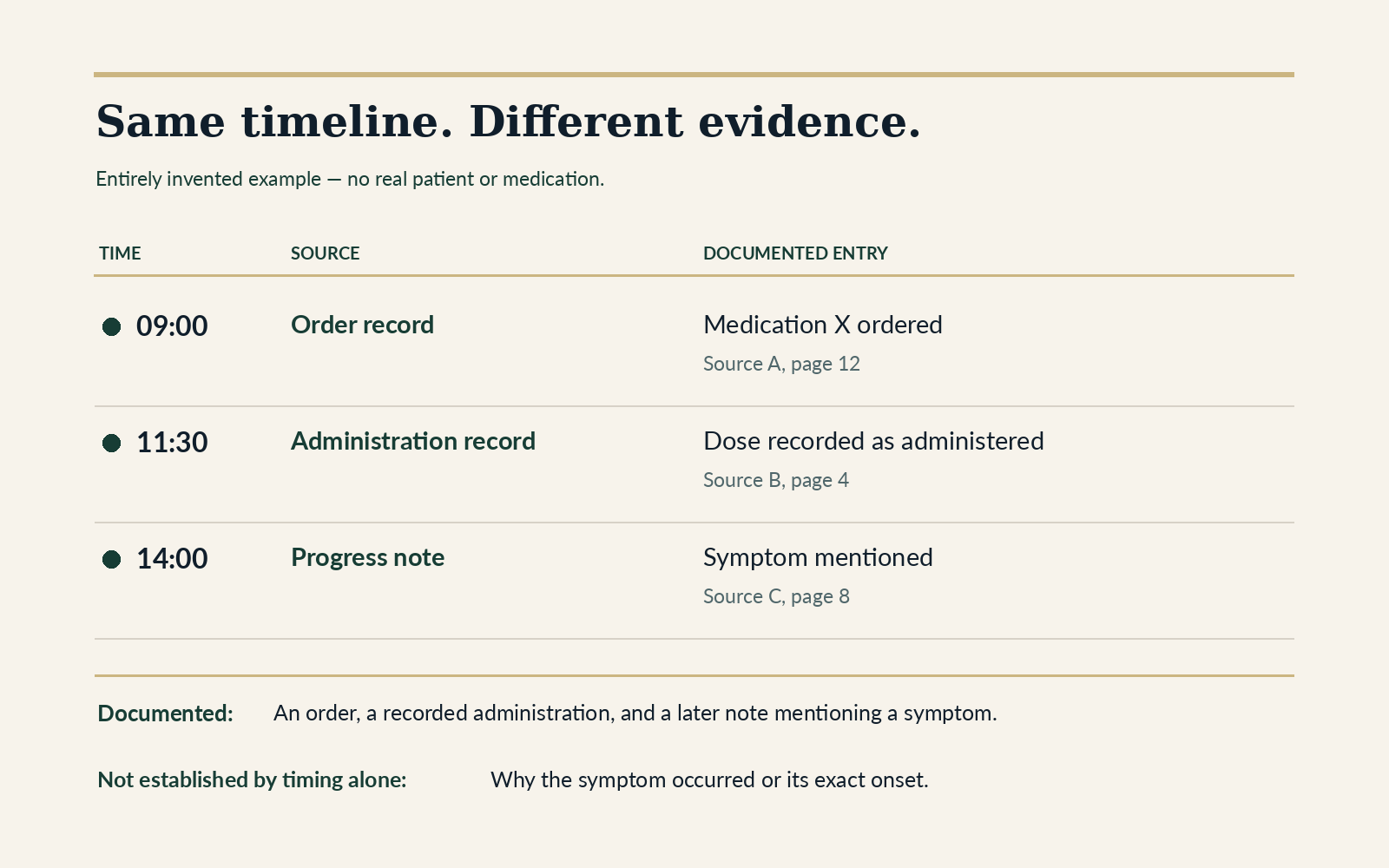
One date, three different statements
Entirely invented example. No patient, medication, or client engagement is represented.
- 09:00 — Order record, source A, page 12
- An order is entered for Medication X. This documents the order; it does not itself document administration.
- 11:30 — Administration record, source B, page 4
- A dose of Medication X is recorded as administered. Preserve the dose and route as recorded in the source.
- 14:00 — Progress note, source C, page 8
- The note mentions a symptom. It establishes that the symptom was documented here; the entry alone does not establish why it occurred or its exact onset.
A useful summary is: “The supplied records document an order, a recorded administration, and a later note mentioning a symptom.” A stronger causal claim would require additional analysis. The timeline should not smuggle that conclusion into its event labels.
The distinction is familiar in safety reporting too: FDA explains that an adverse-event report does not by itself establish that a product caused the event.[2] That reporting limitation is not a method for deciding an individual matter; it illustrates why a reported sequence and a supported explanation must remain distinct.
What if medication records disagree?
Keep both entries visible. Identify the particular difference: dose, frequency, date, medication identity, or whether an action is documented at all. Then state which source or clarification could help resolve it.
For example, a home medication history and an inpatient order may differ for an intentional clinical reason. AHRQ’s reconciliation guidance emphasizes comparison and clarification of medication discrepancies.[1] A retrospective reviewer should document the difference and look for an explanation rather than assume an error.
If a correction or addendum exists, preserve its relationship to the original entry. Avoid silently replacing an earlier record in a way that conceals the documentation sequence. The reader needs to see both the clinical event and how it was recorded.
A missing entry is a question, not a completed explanation
“No administration entry located in the supplied pages for this interval” describes the reviewed material. “The dose was not given” makes a different claim. Before making it, the reviewer needs to consider the completeness of the record set and any other relevant evidence.
Useful gap notes specify the affected period, the source reviewed, and the document or clarification being sought. A generic “records incomplete” note is easy to overlook. A specific gap can guide the next request.
The same care applies to repeated entries. Several copies of one note are not several independent observations. Label duplicates and copied-forward material when identifiable, and preserve the original source reference.
What should you receive?
A focused timeline assignment can provide an organized chronology, source index, unresolved discrepancies, and questions for follow-up. If you also need a clinical findings report or a literature review, include that in the proposal.
A timeline arranges the record. A findings report evaluates defined questions. A literature summary examines external evidence. Combining those outputs can be useful, but each should be identifiable. See the attorney records review guide and targeted research guide for the related services.
How to request a medication timeline
Send PCS the clinical question, covered dates, approximate record volume, document types, intended use, and deadline. Begin with a general description; confidential sharing arrangements and any relevant conflict check come before substantive review.
PCS can clarify the assignment and propose the deliverable, fee, timing, and follow-up arrangements. There is no need to organize the entire case before asking for a quote. Read the consulting inquiry guide for what to send.
Request a Medication Timeline Quote and describe the sequence your team needs to understand.
Frequently asked questions
Is a medication timeline the same as a medication list?
No. A list describes medications at a point or period; a timeline follows documented events and changes over time. The timeline fields show how source and event information stay connected.
Can a timeline establish that a medication caused harm?
Timing can inform a clinical question, but chronology alone does not establish causation. A separate, defined analysis may require more records and relevant evidence. Discuss the question with PCS when requesting the assignment.
What if the dates or doses conflict?
Retain both source entries, identify the difference, and record what needs clarification. See handling conflicting entries and the records review guide.
Can PCS provide a written analysis alongside the chronology?
A findings report or focused evidence summary can be proposed with the timeline. The consulting inquiry guide explains how to describe the output you need; request a quote for the combined assignment.
References
- Agency for Healthcare Research and Quality. MATCH Toolkit, Chapter 3: Designing the Medication Reconciliation Process. Clinical care guidance on comparing medication information and clarifying discrepancies.
- U.S. Food and Drug Administration. FDA Adverse Event Monitoring System (AEMS) Public Dashboard. Reporting-data limitations; not a case-specific causation determination.
Need medication-focused analysis?
Request records analysis or research with a written deliverable tailored to your question. Send your project details and deadline for a quote.
More from the Review
Scroll or swipe to explore related articles. When the article list is focused, use the left and right arrow keys; Home and End jump to the beginning and end.
What Medication Records Can—and Cannot—Establish
An order, a claim, and a clinical note do not establish the same thing. Learn how a focused review separates documented findings from unresolved questions.
Read article : What Medication Records Can—and Cannot—Establish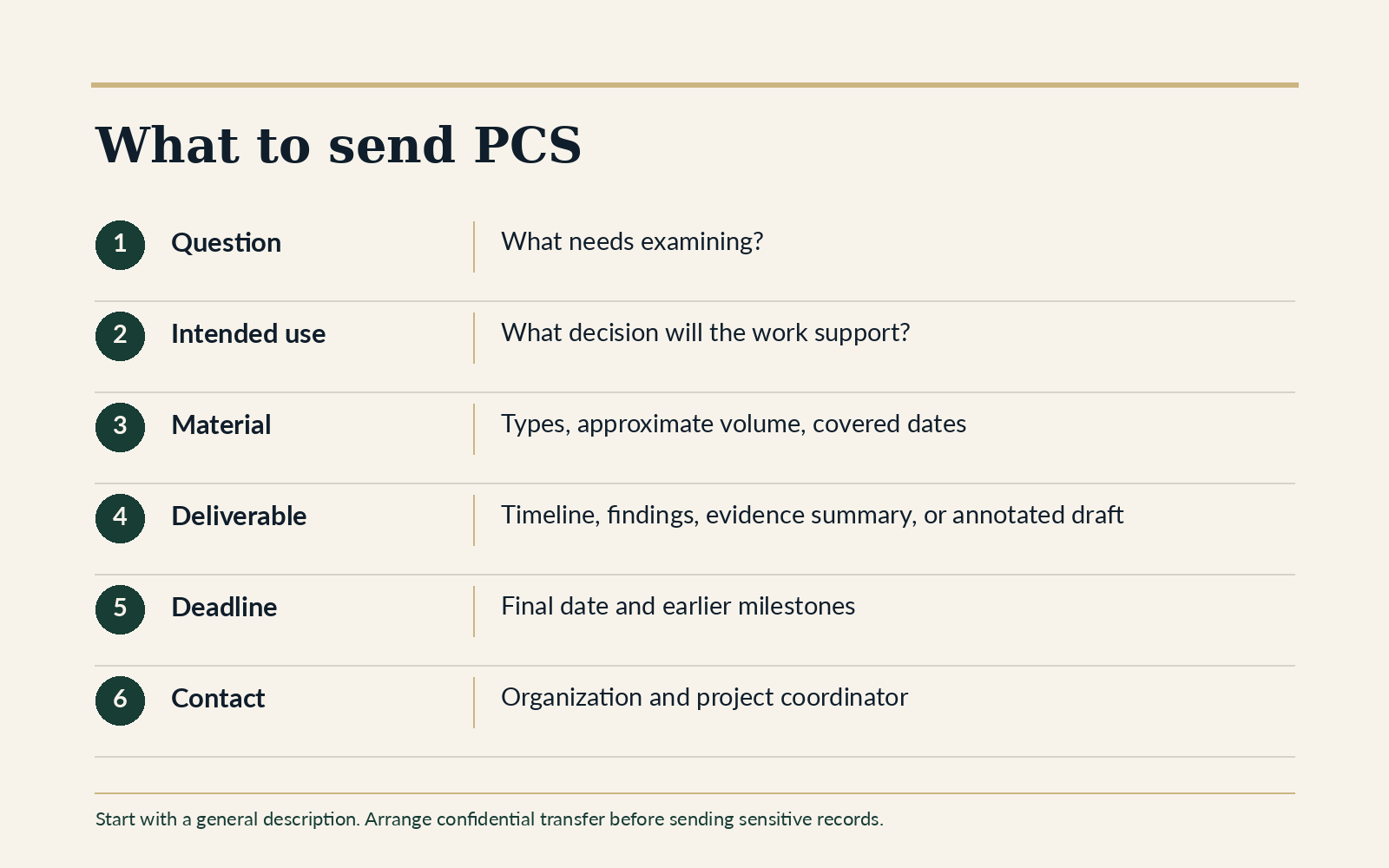
Preparing a Pharmaceutical Consulting Inquiry: Questions, Records, and Scope
You do not need to solve the clinical question before asking for help. Here is what to send PCS to define the assignment and request a proposal.
Read article : Preparing a Pharmaceutical Consulting Inquiry: Questions, Records, and Scope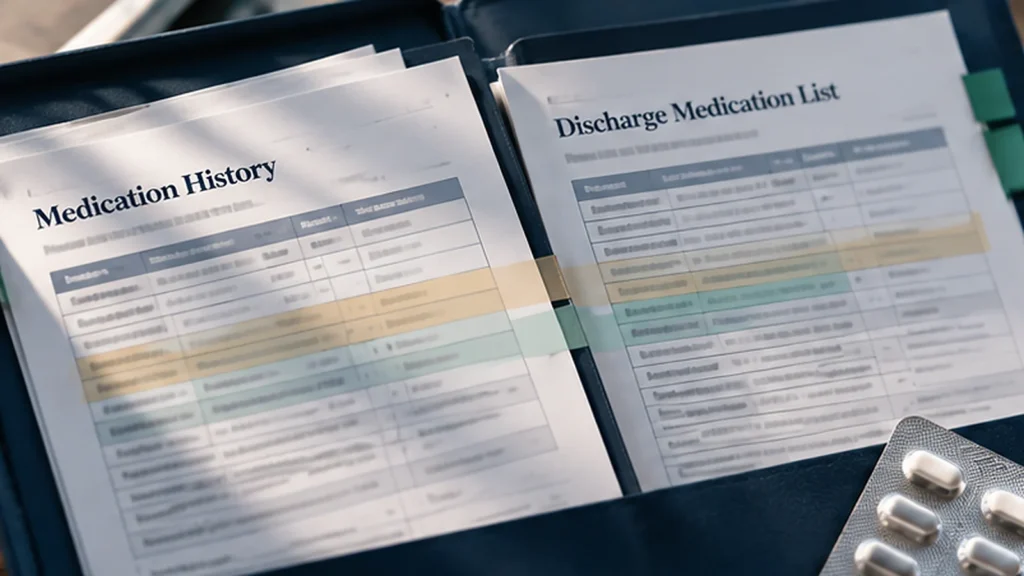
Pharmacist Medical Record Review for Attorneys: What to Expect
Medication entries tell different parts of a clinical story. See how a focused records review can organize the documented events, discrepancies, and questions your legal team needs to examine.
Read article : Pharmacist Medical Record Review for Attorneys: What to ExpectPatient Education Writing Services: What to Commission and What You Receive
A patient resource needs more than accurate sentences. See how to commission clear, referenced materials built around your audience and their next step.
Read article : Patient Education Writing Services: What to Commission and What You Receive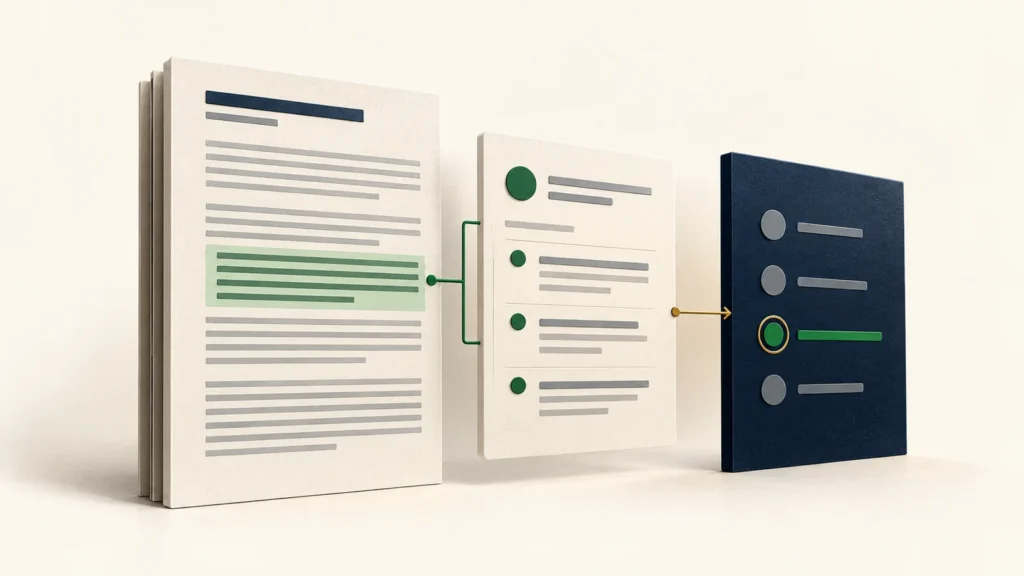
How to Request a Pharmacist Peer Reviewer for a Medical Journal
A useful peer-review invitation identifies the clinical question, expertise needed, and deadline. Here is what journal editors can send—and how authors can request a separate manuscript review.
Read article : How to Request a Pharmacist Peer Reviewer for a Medical Journal
Updating Medical Website Content: What to Review, Rewrite, or Retire
An older medical article may need a targeted correction, a full rewrite, or a different place in the site. Use a practical review process to decide what changes and who handles the update.
Read article : Updating Medical Website Content: What to Review, Rewrite, or Retire