Updating Medical Website Content: What to Review, Rewrite, or Retire
An older medical article may need a targeted correction, a full rewrite, or a different place in the site. Use a practical review process to decide what changes and who handles the update.

Quick answer
Updating medical website content involves reviewing clinical claims and references, deciding an action for each page, revising connected passages, and recording the work performed. A defined assignment can cover a page inventory, clinical findings, and updated copy for the agreed pages.
Have an article or manuscript to review? Request a Review Quote.
Updating medical website content starts with a decision about each page: keep it, correct it, rewrite it, combine it with another resource, or remove it from publication. The work should leave readers with useful information and your team with a clear record of what changed.
Picture a medication article that has been quietly doing its job for years. The introduction still reads well. The links mostly open. Then someone notices that a recommendation rests on an older guideline, and nobody is sure which other pages repeat it.
PharmacoLegal Consulting Services™ can review existing medical articles and medication resources, identify the revisions needed, and quote for updates or rewritten content. Explore clinical content review or request a content review quote for a page or a group of pages.
Which pages should you review first?
Begin with content that could affect a reader’s understanding of treatment: medication use, benefits and harms, warnings, monitoring, or recommendations. Give attention to pages affected by a known evidence or guidance change, a reader complaint, or a concern raised by your clinical team.
Then consider where people actually arrive. A widely visited page with an unresolved clinical question deserves prompt attention. Use your page inventory and available traffic information to organize the queue; low traffic does not make a potentially misleading statement acceptable.
FDA’s Drug Safety Communications explain that new safety information can lead to changes in prescribing information or patient Medication Guides.[1] That is one reason a medication page may need another review after its original publication.
Build an inventory your editor can use
For each page, record the URL, topic, intended reader, publication or last substantive review date, and the question that triggered the update. Add the current version or a saved copy so the team can track what was assessed.
You can start with a small group. Five related medication explainers may be a more useful first assignment than an undefined request to “refresh the website.”
Identify who will approve clinical changes and who will publish the revised copy. If the same explanation appears in a downloadable handout or another article, include that connection in the inventory.
Check the clinical content before polishing the prose
Ask whether the important claims remain supported by appropriate sources. Check the population, treatment comparison, outcomes, uncertainty, and any advice the reader might take from the page.
Look beyond publication year. An older study can remain relevant, while a newer reference can still fail to support a sentence. The reference-checking guide explains how to assess the connection between a claim and its citation.
Review medicine names, formulations, units, and the context of any treatment instructions. A change to one passage may require corresponding edits elsewhere so the article remains internally consistent.
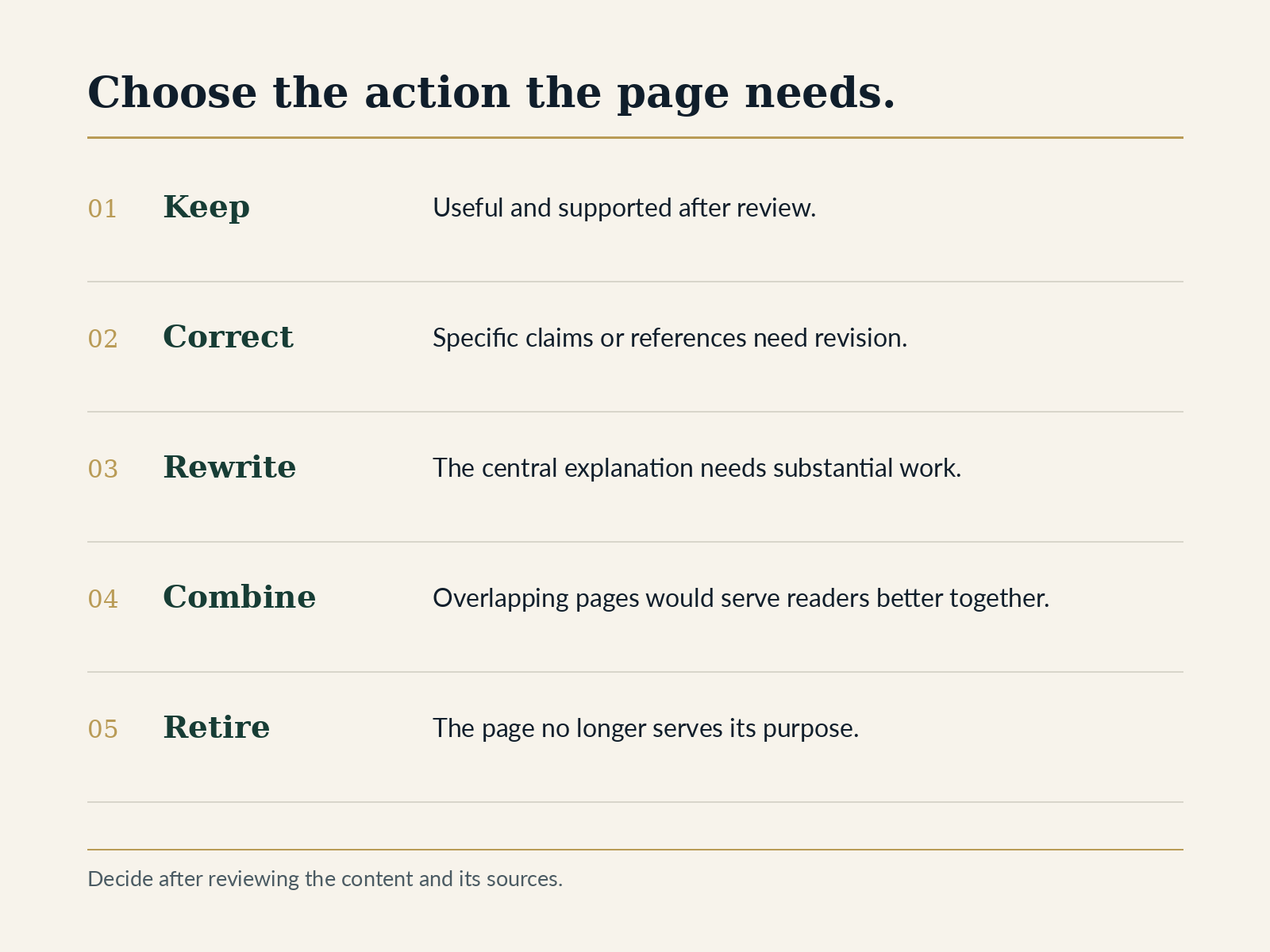
Review, rewrite, combine, or retire?
A practical content review should recommend an action and explain why. Here is a useful starting framework.
- Keep
- The page still answers a useful question and the assessed claims remain supported. Record what was checked.
- Correct
- The overall article works, but specific statements, references, or explanations need revision.
- Rewrite
- The structure or central explanation needs substantial work to serve the intended reader.
- Combine
- Several pages answer substantially the same question, and a unified resource would make the information easier to use.
- Retire
- The page no longer serves its intended purpose and cannot usefully be corrected or incorporated elsewhere.
For a real page, choose the action after reviewing the content. If a URL is being removed or consolidated, your web team should handle navigation, redirects where appropriate, and any other technical consequences.
A worked example: one passage, several connected edits
Original editorial demonstration. This imagined example does not describe a medicine, real guidance change, or client project.
A page summarizes an older recommendation. The reviewer finds that the relevant guidance now distinguishes two patient groups, while the page addresses them as one.
- Clinical task: check the current source, the populations it covers, and what the change means for the page’s claims.
- Writing task: revise the affected explanation, heading, and FAQ answer so they tell a consistent story.
- Publishing task: update the references and review record, and check other pages or handouts that repeat the explanation.
Changing a sentence without checking those connections can leave the old message elsewhere on the site. A useful update follows the claim through the places readers encounter it.
Read the revised page from the reader’s perspective
Does the opening answer the question? Can a patient understand the explanation without mistaking general information for a personal treatment instruction? Do headings and graphics help the reader follow the meaning?
CDC’s Clear Communication Index offers research-based criteria for assessing public communication.[2] MedlinePlus also encourages readers to look for sources, qualifications, a review process, and meaningful dates when assessing health information.[3]
Show the actual work performed. Record a substantive update when the content has been changed or assessed; changing a date alone does not resolve an unsupported claim.
What should your team receive?
For a group of pages, the proposal can include an inventory with recommended actions, annotated clinical findings, and revised copy for the agreed pages. State whether the assignment includes new research, direct editing, a final recheck, or publishing support.
The review report guide shows how findings can lead to useful decisions. If substantial new copy is needed, the medical writer hiring guide explains the commissioning process.
To start, send the page URLs, audience, approximate volume, any known concerns, and deadline. Request a Content Review Quote and receive a proposal covering the work, deliverables, fee, and timing.
Frequently asked questions
Can you review just a few pages?
Yes. A single article or defined group of pages can be considered. Send the URLs, topic, reader, and deadline through the review inquiry.
Does every older medical article need rewriting?
No. Review whether the information remains supported and useful. Some pages need targeted corrections; others need substantial rewriting. See how writing, editing, and review differ.
Can you review content that was created with AI?
Yes. Describe how it was produced and whether references are available. The AI medical content review guide explains the checks that matter before publication or republication.
Will a content update improve our Google rankings?
Rankings are not guaranteed. The assignment improves the agreed content and its evidence support; technical SEO and search performance require their own assessment. Start with the clinical review service when your question is whether the medical information needs correcting.
References
- U.S. Food and Drug Administration. Drug Safety Communications.
- Centers for Disease Control and Prevention. Clear Communication Index User Guide.
- National Library of Medicine. MedlinePlus. Evaluating Health Information.
Have a draft that needs a clinical review?
Get annotated feedback on medication accuracy, source support, and clinical context. Send your project details and deadline for a quote.
More from the Review
Scroll or swipe to explore related articles. When the article list is focused, use the left and right arrow keys; Home and End jump to the beginning and end.
Patient Education Writing Services: What to Commission and What You Receive
A patient resource needs more than accurate sentences. See how to commission clear, referenced materials built around your audience and their next step.
Read article : Patient Education Writing Services: What to Commission and What You Receive
AI-Written Medical Content: What Needs Checking Before Publication?
A convincing draft still needs its claims checked. Explore the reference, clinical meaning, medication, and audience checks an AI-assisted medical article needs before publication.
Read article : AI-Written Medical Content: What Needs Checking Before Publication?
Hiring a Medical Writer: What to Send and What to Expect
You do not need a finished brief to start. Here is what to send, what a medical writing proposal should cover, and how an inquiry becomes a commissioned article.
Read article : Hiring a Medical Writer: What to Send and What to Expect
Common Accuracy Problems in Medication Content
A polished medication article can still imply more than its evidence supports. Six practical review targets reveal where meaning can shift—and how to document a useful correction.
Read article : Common Accuracy Problems in Medication Content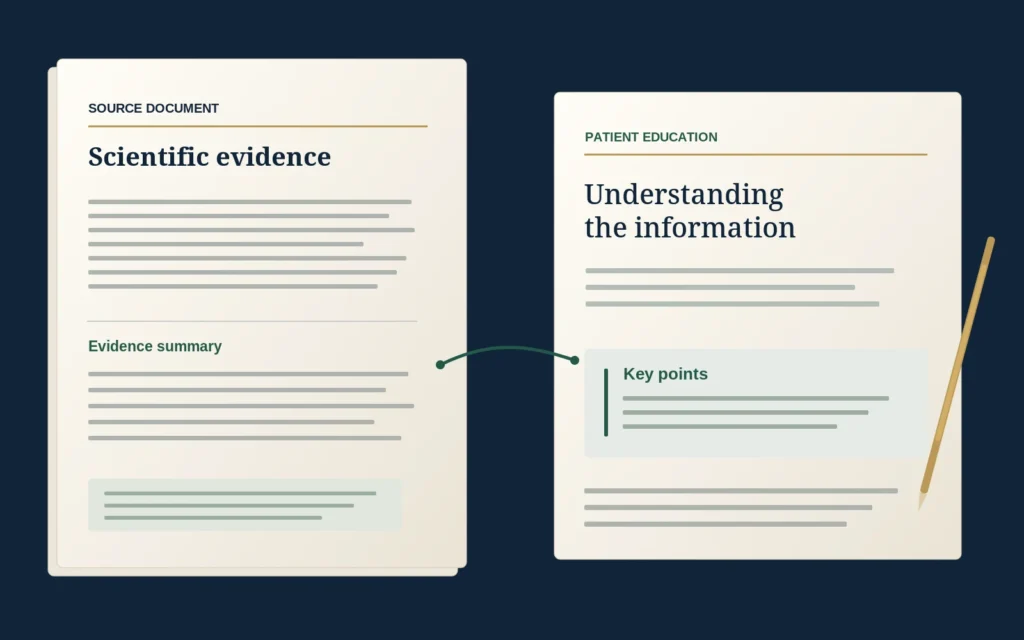
From Clinical Evidence to Clear Patient Education
Making clinical evidence easier to read is only the start. Explore how patient education can preserve qualifications, explain numbers, and serve a clear reader purpose.
Read article : From Clinical Evidence to Clear Patient Education
What to Include in a Medical Writing Brief
A topic, word count, and deadline are the beginning of a conversation. Use this practical guide to define the writing assignment before assumptions become revisions.
Read article : What to Include in a Medical Writing Brief