Hiring a Medical Writer: What to Send and What to Expect
You do not need a finished brief to start. Here is what to send, what a medical writing proposal should cover, and how an inquiry becomes a commissioned article.
Quick answer
When hiring a medical writer, send the topic, intended reader, type of content, approximate length, starting material, and deadline. Agree the deliverables, research, revisions, fee, and timeline in a written proposal before work begins.
Need medical content written for your audience? Request a Writing Quote.
Hiring a medical writer starts with the work you need. Send the topic, intended reader, type of content, approximate length, and deadline. Those details give the conversation somewhere useful to begin.
Imagine your team needs an article explaining a medication topic. Someone has a title. Someone else has three papers. The deadline is real; the brief is still taking shape. You do not need to finish the article before asking a writer to write it.
PharmacoLegal Consulting Services™ writes referenced medical articles, medication explainers, and patient education. Explore medical writing services or request a writing quote for your project.
Start with what you want to commission
Describe the finished piece: a patient article, a clinician-facing explanation, a medication resource, or a series of healthcare articles. Then say what the reader should understand or be able to do after reading it.
“An article about treatment options” leaves a great deal open. “A patient-facing article explaining the questions to discuss with a clinician before starting treatment” gives the writer a purpose and a reader.
If you already have a complete draft, your first need may be editing or clinical content review. The service comparison helps you choose the right assignment.
What to send in your first inquiry
Five details are enough to start:
- The content: what you want written and the topic.
- The reader: patients, caregivers, clinicians, or another defined audience.
- The size: an approximate word count, number of pieces, or expected format.
- The starting material: whether you have an outline, source pack, existing content, or a blank page.
- The deadline: when you need the draft and, if different, the finished piece.
You can say “not decided yet” where you need guidance. A short inquiry is enough to start.
For the fuller planning checklist after the project takes shape, use the medical writing brief guide. You do not need to complete a lengthy brief before contacting PCS.
A useful inquiry in five sentences
Illustrative project request—not a client testimonial or a published engagement.
We need a patient-facing article about understanding a new medication prescription. The audience is adults preparing for a conversation with their clinician or pharmacist. We are planning approximately 1,000 words for our healthcare website. We have an outline and would like the writer to identify suitable references. Please quote for a first draft, a reference list, and one consolidated revision round, with the draft needed by [date].
That request gives a writer enough to ask focused follow-up questions. It identifies the work, the reader, the starting point, and the timing. The requested revision round is an example; the actual inclusion is agreed in your proposal.
What should you receive?
For a commissioned article, ask for a proposal that identifies the draft format, approximate length, research and reference requirements, delivery date, and revisions included.
A PCS writing assignment can include:
- An outline, when useful: a chance to settle the structure before the full draft.
- Referenced copy: content written for the agreed reader and purpose.
- A usable reference list: sources your team can check and carry into publication.
- Agreed revisions: changes based on the feedback process defined in the proposal.
Figures, original graphics, interviews, extra articles, a separate clinical review, and website upload should be identified when required. They are not automatically included because the project is described as “an article.”
AMWA recommends defining the project objective, audience, deliverables, reviewer involvement, revisions, and timeline when agreeing a writing assignment.[1] Clear inclusions help both sides plan the work.
How to judge a medical writing sample
Look beyond how polished the opening sounds. Can you identify the intended reader? Does the explanation answer a real question? Can the important claims be traced to suitable sources? Does the writer explain uncertainty without burying the message?
A clinician and a patient may need different explanations of the same evidence. CDC’s communication framework asks who the audience is, what the communication should accomplish, and which main message the reader needs to retain.[2]
The physician-versus-patient writing guide shows how that distinction changes the work. The medical writing service page also helps you assess the type of content PCS can produce.
What happens after you contact PCS?
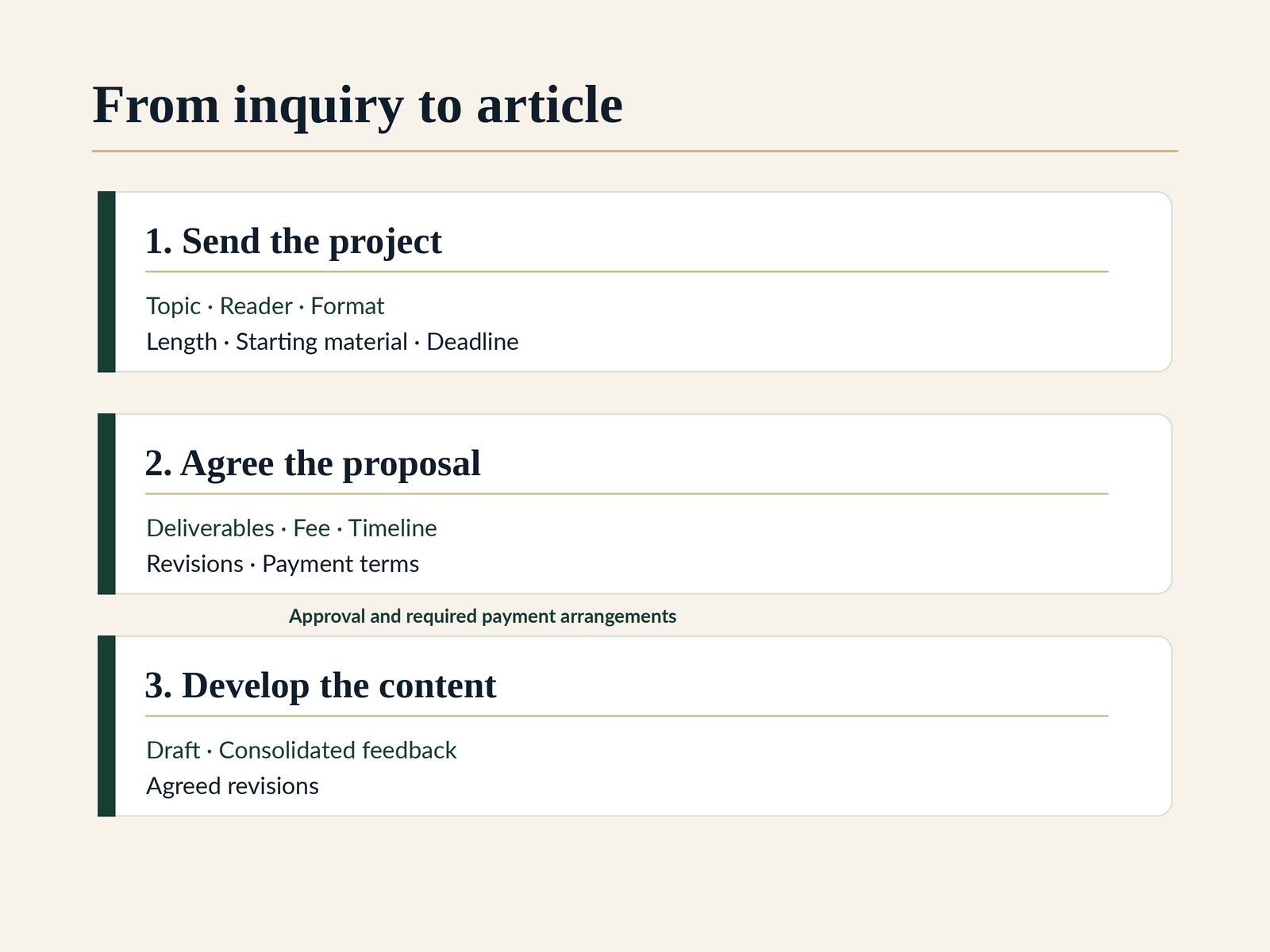
- Clarify the assignment. PCS reviews your request and follows up by email or a project-fit conversation when helpful.
- Receive a proposal. You receive the proposed deliverables, fee, timeline, revisions, and payment terms.
- Approve and begin. Work starts after the agreement and required payment arrangements.
- Review the draft. Your designated reviewer gathers feedback for the agreed revision process.
You do not have to book a call to discover what PCS offers. Start with the project details. A conversation is useful when it helps settle the assignment.
For journal manuscripts, discuss contributor credit and the journal’s requirements at the outset. Writing assistance alone does not establish authorship under ICMJE’s criteria; contributors should be credited appropriately.[3]
Ready to commission medical content?
Send the topic, reader, format, approximate length, and deadline. If you need several pieces or continuing support, include the expected volume and publishing schedule.
Request a Writing Quote. PCS will clarify the work and provide a proposal before you commit.
Frequently asked questions
Do I need a finished brief before hiring a medical writer?
No. Start with the topic, reader, content type, approximate length, and deadline. The writing brief guide helps with the next level of planning; it is not a prerequisite for an inquiry.
Can PCS write for both clinicians and patients?
PCS offers clinician-facing and patient-facing medical content, with the audience agreed for each piece. Read what changes between physician and patient articles, then request a writing quote for the version you need.
How much does medical writing cost?
The project fee depends on the content, research, length, deliverables, and timeline. Send those details for a proposal. You receive the fee and inclusions before work starts.
Can you help if we already have a draft?
Yes. Describe whether it needs clearer writing, reference checking, or clinical assessment. The writing, editing, and review guide explains the options, and the clinical review report guide shows what actionable feedback looks like.
References
- American Medical Writers Association. How to Write a Scope of Work for Your Next Freelance Writing Project. February 1, 2021.
- Centers for Disease Control and Prevention. CDC Clear Communication Index.
- International Committee of Medical Journal Editors. Defining the Role of Authors and Contributors.
Need medical content for your audience?
Commission referenced articles, medication explainers, or patient education with agreed revisions. Send your project details and deadline for a quote.
More from the Review
Scroll or swipe to explore related articles. When the article list is focused, use the left and right arrow keys; Home and End jump to the beginning and end.
Patient Education Writing Services: What to Commission and What You Receive
A patient resource needs more than accurate sentences. See how to commission clear, referenced materials built around your audience and their next step.
Read article : Patient Education Writing Services: What to Commission and What You Receive
Updating Medical Website Content: What to Review, Rewrite, or Retire
An older medical article may need a targeted correction, a full rewrite, or a different place in the site. Use a practical review process to decide what changes and who handles the update.
Read article : Updating Medical Website Content: What to Review, Rewrite, or Retire
AI-Written Medical Content: What Needs Checking Before Publication?
A convincing draft still needs its claims checked. Explore the reference, clinical meaning, medication, and audience checks an AI-assisted medical article needs before publication.
Read article : AI-Written Medical Content: What Needs Checking Before Publication?
Common Accuracy Problems in Medication Content
A polished medication article can still imply more than its evidence supports. Six practical review targets reveal where meaning can shift—and how to document a useful correction.
Read article : Common Accuracy Problems in Medication Content
From Clinical Evidence to Clear Patient Education
Making clinical evidence easier to read is only the start. Explore how patient education can preserve qualifications, explain numbers, and serve a clear reader purpose.
Read article : From Clinical Evidence to Clear Patient Education
What to Include in a Medical Writing Brief
A topic, word count, and deadline are the beginning of a conversation. Use this practical guide to define the writing assignment before assumptions become revisions.
Read article : What to Include in a Medical Writing Brief